Four ways out of the haze
The painters we lump together as Post-Impressionists never formed a group; the label was coined later, in London, to mean roughly “the interesting ones who came after.” What they shared was a complaint — Impressionism had dissolved the world into shimmering light and lost its bones — and they took four different escape routes out of the same building, each convinced the others were fleeing the wrong way.
Georges Seurat turned it into a science: he painted in thousands of tiny, deliberate dots of pure color — pointillism — arranged by optical theory, and built a vast Sunday park scene as still and ordered as an Egyptian frieze. Paul Cézanne went the opposite way, alone in Provence, rebuilding apples and mountains out of blunt facets of color until a painting felt as constructed as a stone wall. He is the hinge of this whole story: the man Picasso and Matisse would each call their father.

Van Gogh and Gauguin
The other two routes went looking for emotion. Vincent van Gogh, a Dutch ex-preacher who painted seriously for barely a decade and, by the established record, sold a single painting in his lifetime, loaded his color and clawed his brushstrokes until a wheat field or a night sky seemed to carry his own nervous charge — color wired straight to feeling, with no polite filter in between. His on-and-off friend Paul Gauguin went searching for an imagined “primitive” innocence and never stopped moving to find it: he quit a Paris stockbroking desk, failed at it in Brittany, sailed to Panama and Martinique, came back, and finally fetched up in Tahiti and the Marquesas, painting in flat, walled-off zones of unreal color. The “innocence” was always his own projection — and, as we now reckon with, was bound up with a colonial fantasy that used the islands and their young women as scenery.
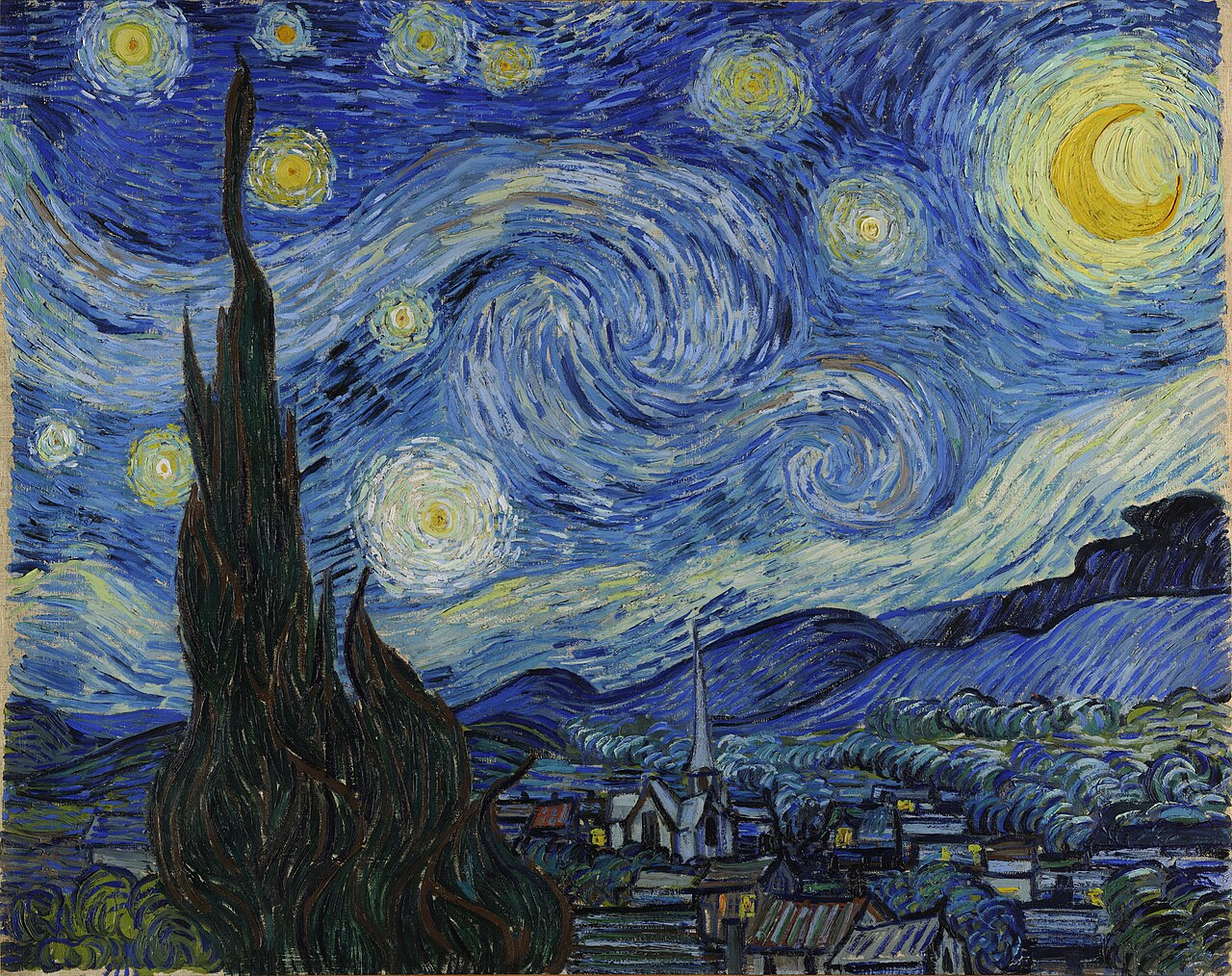
Between them, these four had cracked the picture open in every direction at once — toward science, toward structure, toward raw feeling, toward flat unreal color. A generation of much younger painters in Paris inherited all four exits at the same moment. And, being young, they took all four.