Color off the leash
At the Salon d’Automne of 1905 a room of canvases by Henri Matisse and his friends hit visitors like a shout: a portrait with a green stripe running down the sitter’s face, skies and shadows painted whatever color the picture seemed to need rather than the color the world actually was. A critic called them les fauves — the wild beasts. Fauvism barely lasted three years, but like a lot of movements in this era it burned bright and fast because it had only one point to make, and it made it: color does not have to describe anything. It can just be the painting’s engine.

Then perspective itself is repealed
If Matisse freed the color, Pablo Picasso and Georges Braque went after the deeper rule — the single fixed viewpoint that had made a painting behave like a window since the 1400s: one eye, one spot, one frozen instant. Starting from Cézanne’s facets and from West and Central African sculpture — Fang, Kota and other masks Picasso met at Paris’s ethnographic museum in 1907 — the two of them spent years showing several sides of an object on the flat canvas at once. They named nothing and declared nothing; they just did it, roped together in neighboring studios, until the window was gone.
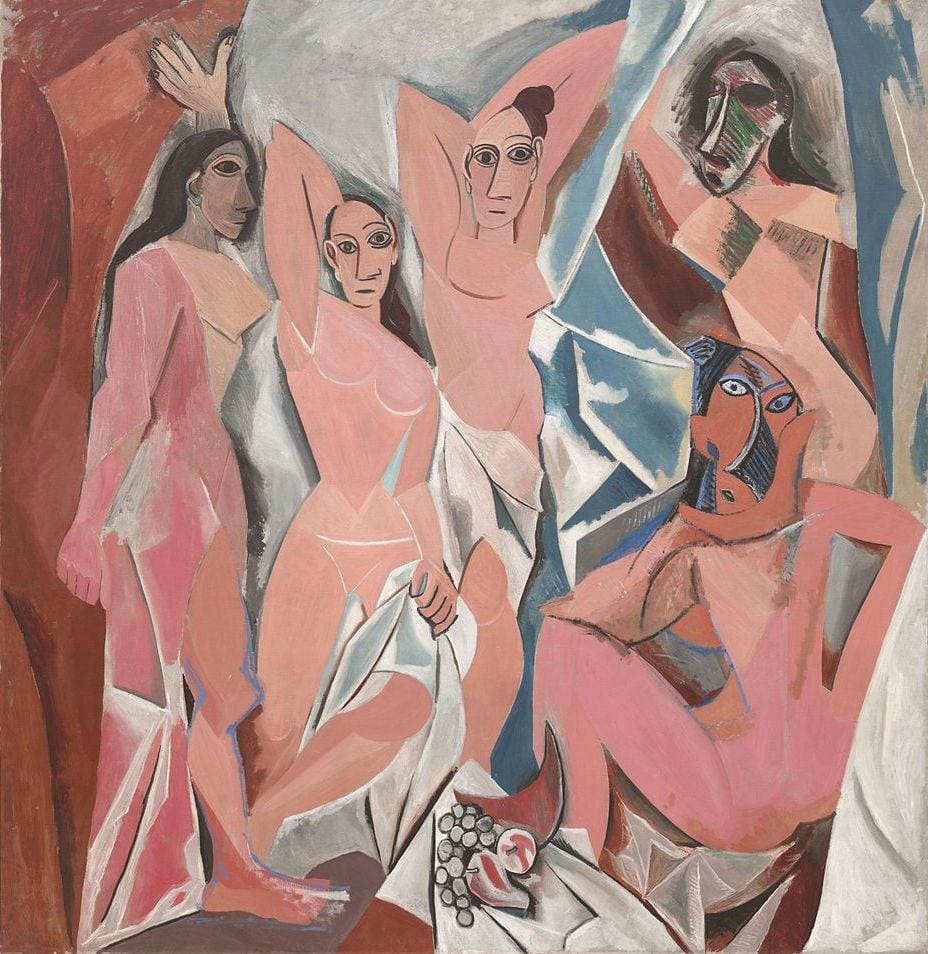
Cubism is the pivot of the whole era, which is why it has its own read one level down — six chapters on Picasso, Braque, collage and the war that broke them apart. What matters here is the door it left open. If a painting owes nothing to color-as-description (Matisse) and nothing to single-point perspective (Cubism), then it owes nothing to the visible world at all. From this moment, abstraction is only a matter of nerve.