The one room that mattered
For two hundred years there had been exactly one way to be a painter in France: get into the Salon. It was the official exhibition of the Académie des Beaux-Arts — the French state’s art establishment — and it was the only theater in town. A jury of professors decided what hung. They wanted polished surfaces, noble subjects (gods, battles, scripture) and no visible brushwork. The whole of Western modern art is, in one sense, a hundred-year argument with that jury.
The first to pick the fight was Gustave Courbet, who painted ordinary people — stonebreakers, a village funeral — at the vast, heroic scale the Salon reserved for kings and saints, in thick, earthy, trowelled-on paint that refused to prettify anyone. In 1855, when the world’s fair turned down his biggest canvases, Courbet did the unheard-of thing: he put up his own building across the street, charged admission, and called it the Pavilion of Realism. A painter could now go around the jury entirely — which is roughly the nineteenth-century equivalent of being rejected by every gallery and opening your own.

The pictures that started the war
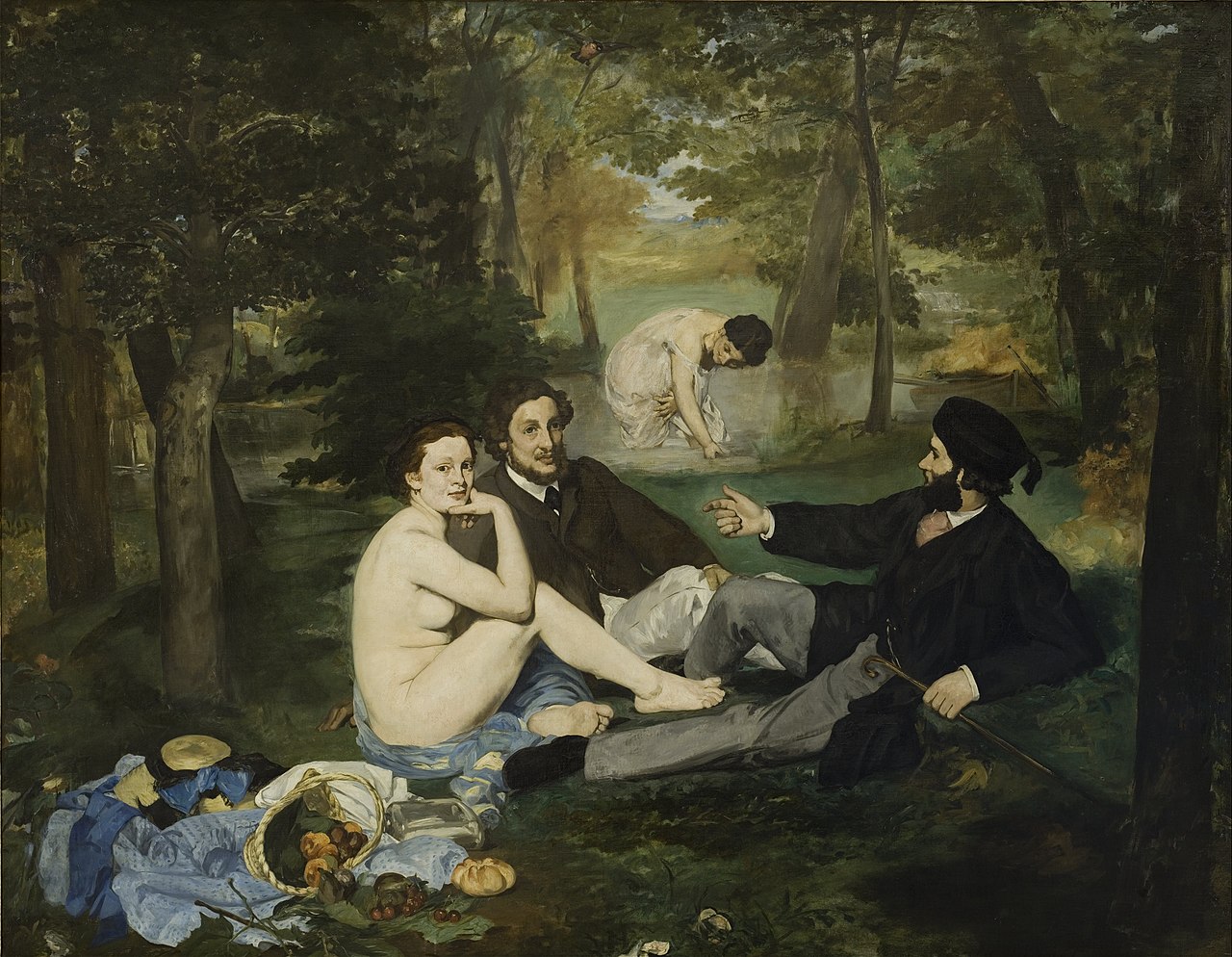
Two things broke in 1863. First, the jury rejected so many painters that the Emperor ordered an overflow show — the Salon des Refusés, the Salon of the Rejected — so the public could come and laugh at the art the jury had thrown out. Second, the star of that freak show was Édouard Manet, whose Déjeuner sur l’herbe sat a plainly naked, plainly modern woman at a picnic between two clothed men and had her gaze straight out at you, entirely unbothered. It was not the nudity — the Salon was wall-to-wall nudes. It was that she was obviously a real Parisian, here and now, not a goddess with an alibi; and that Manet painted her in flat, blunt patches instead of the smooth, blended shading (the “modelling”) that made academic flesh look rounded and real. The audience felt mocked.
He did it again two years later, and worse. Olympia showed a naked Parisian courtesan — a high-priced kept woman — reclining on her bed and meeting your eye with the flat, businesslike stare of someone deciding whether you can afford her. At the 1865 Salon, contemporaries report, it had to be re-hung high on the wall, out of reach of the umbrellas and walking sticks of visitors who genuinely wanted to attack it.

The richest irony of all: Manet never wanted to be a rebel. He craved the Salon’s approval his whole life and was wounded every time it withheld it. The man who did more than anyone to destroy the jury’s authority spent his career desperate for its medal. But he had handed the next generation two ideas that would not go back in the box — paint the modern world as it is, and let the paint look like paint — and a group of younger admirers took both to heart and went outside.