One ladder, and the State owned it
Before anybody breaks anything, look at what there was to break. In France around 1850 there was exactly one way to become a painter, and it was less a profession than a single narrow staircase with the State standing at the top of it. The Académie des Beaux-Arts (the art wing of the Institut de France, the country’s official body of approved excellence) decided what counted as good painting, trained the painters who made it, and showed the results once a year in one enormous public hall. Climb that staircase and you had collectors, commissions, a name. Miss it and you did not have a career. You had a hobby.
The training was a long boot camp, and the order in which you were allowed to do things tells you everything about what the institution valued. At the École des Beaux-Arts (the state art school) a student spent years drawing — first from plaster casts of antique statues, then from the live model — before he was trusted to touch serious paint at all. He, and it mattered: the official school admitted no women at all until 1897. A woman who wanted real training got it in the private studios — the Académie Julian, opened in 1868, was the famous one, and it gave its women students the thing the École withheld, a live nude model to draw from. For half the population the State staircase simply had no bottom step. The supreme prize was the Prix de Rome (a State-funded scholarship to study the old masters), which shipped its winner off to the Villa Medici in Rome at the country’s expense to copy the masters for years on end. The house style this machine produced prized fini (a surface blended so smoothly that you could not find a single brushstroke if you went looking) — the paint was supposed to disappear, leaving only the picture — and clean line and drawing over loose, expressive color.
And it enforced a strict pecking order of subjects, a ranking formalised back in 1667 by the royal court historian André Félibien and still running the show two centuries later — the hierarchy of genres. Think of it as a caste system for things you could paint. At the very top sat history painting (grand scenes from myth, scripture, ancient history and allegory, full of the human body at heroic size), the only category serious enough to win a man real glory. At the very bottom sat the still life — a bowl of fruit, a dead pheasant, painted small. The principle was blunt: gods at the top, a bowl of fruit at the bottom, with the more ordinary subjects strung out in between. A young painter who wanted respect painted gods, not greengrocers.
Where careers were made and skied
All of it funnelled into a single event. The Salon was the Académie’s official public exhibition, and it was the only theater in town — the one place where a wide Paris public, hundreds of thousands of people, came each year to look at, fight over and actually buy new art. The Académie held a monopoly on it right through 1880, so in the 1850s the Salon was, flatly, a State-run institution. What got in was decided by the Salon jury — a panel of Académie members and state appointees who reviewed the year’s submissions and ruled each one in or out. A medal there meant a future; rejection meant the dark. Its home kept moving in these years (it had outgrown the Louvre by 1848 and used various halls through the early 1850s before settling, from 1857, into the cavernous iron-and-glass Palais de l’Industrie), but the experience of it barely changed for a century.
That experience was a wall of paintings stacked frame-to-frame from knee height all the way to the ceiling, dozens of feet up. Run your eye up that wall: the higher a canvas climbed, the harder it was to see, until near the top the pictures were just colored rectangles tilted down at a crowd that would never read them. Where your picture landed decided its fate. The prime band, at eye level, was called being “on the line” — seen, studied, reviewed, sold. A picture hung up near the rafters was said to be “skied,” and a skied canvas was, for all practical purposes, an invisible one: nobody craned their neck three storeys up to discover a genius. The hang was the verdict before the verdict.
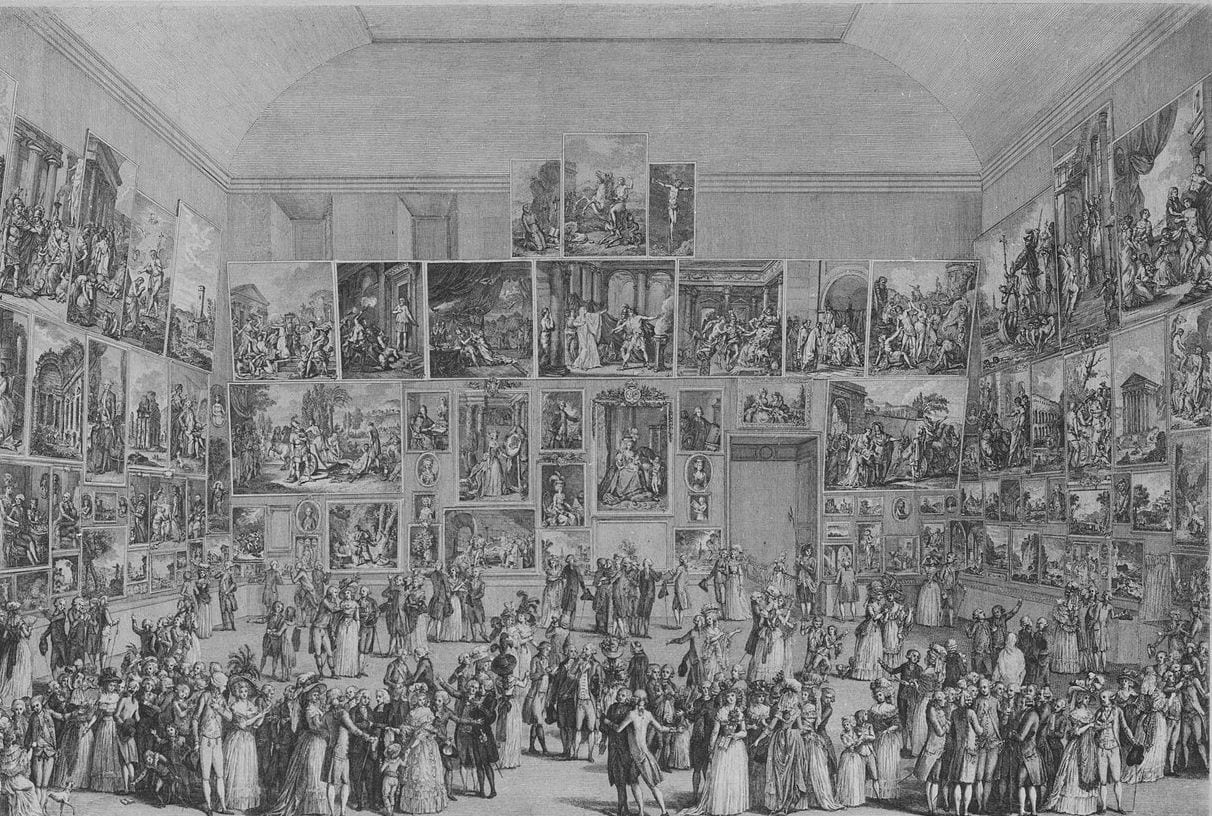
The engraving above shows the Salon of 1787, some sixty years before our moment — it is here because the floor-to-ceiling hang it records had barely changed by 1850.
What the jury loved
So what did all this training, all this State machinery, actually want a painting to look like? Stand in front of Alexandre Cabanel’s The Birth of Venus and you have your answer, because the establishment did not merely admire this picture — it embraced it as its own ideal. A nude goddess lies stretched along the crest of a low wave, eyes half-closed, one arm thrown languidly back over her head, her body a single unbroken sweep of pearly, soft-focus flesh. The sea is a flat, untroubled blue-green; a little fizz of foam supports her; a handful of plump cherubs tumble through the air above. Look as hard as you like and you will not find a brushstroke — the surface is licked smooth, fini taken to its limit, the paint sanded out of existence so nothing comes between you and the illusion. Now look at the skin. There is not a pore on it, not a blemish, not a crease where she has lain on the water, no flush of blood, no mark that any real body or any human hand was ever in the room. It is flawless the way a thing is flawless when it has never been alive. And there is the catch: it is technically faultless and slightly too sweet, like a wedding cake.
The jury adored it, and so did the man at the very top: shown at the 1863 Salon, it was bought for the imperial collection by the Emperor, Napoleon III, straight off the wall. Cabanel was elected to the Académie des Beaux-Arts that same year and handed a professorship at the École the next — the institution rewarding the man who had painted its perfect picture and then handing him the next generation to train. Keep this canvas in your eye, because almost everything the coming rebels did, they did against it.

The modern world loads the gun
While the Académie polished its surfaces, the modern world was quietly loading the gun that would go off in its face. The first round had landed already: in 1839 the French government bought the rights to a new invention and released it to the world — the daguerreotype, the first practical photograph, a hard, perfect image fixed on a silvered copper plate. In seconds, and flawlessly, a machine could now do the one job painters had been paid handsomely to do for four hundred years: produce an exact likeness. A portrait painter’s bread suddenly had a competitor that never blinked. That single fact freed painting — or forced it — to go chasing the things a camera could not.
Then the tools themselves changed. In 1841 an American painter in London named John Goffe Rand patented oil paint sold in collapsible metal tubes, the squeezable kind we still use, which for the first time let a painter carry his colors out the door and set up in front of an actual haystack rather than reconstructing it from memory in a studio. (The metal tube is often credited with making plein-air painting — working outdoors, in front of the subject, in the open air — and even Impressionism itself possible. That is the popular version of the story; the truth is that it helped, alongside several other things.) New railways then carried the painter and his portable colors out of Paris to the coast and the countryside for a few francs. And Paris itself was being gutted and rebuilt: from the early 1850s, under Napoleon III, his chief city-planner, Baron Haussmann, drove wide new boulevards through the medieval tangle and lined them with gas lamps, cafés, grand apartment blocks and department-store windows — a glittering, modern spectacle that all but begged to be painted, if only painting modern life had been allowed.
Who decides what a painting is for?
So the table was set, and underneath every costume change to come — the loose brushwork, the wild color, the shattered perspective — it stayed the same fight for a hundred years: who gets to decide what a painting is for? The Académie’s answer was settled and serene. Beauty, in this view, has rules; the Académie knows them; and the Salon is simply where you prove you have learned them. (That is the institution’s attitude put into plain words, not a quotation — nobody at the Académie said it quite like that.) It was a closed system, and for two centuries it had worked beautifully for the people inside it.
What it could no longer do was hold. A new kind of buyer was appearing, and with it the faint beginnings of a private art trade that might one day let a painter live without the jury’s blessing at all. The disruptors were in place; the audience was changing; the painters of the chapters ahead would answer the Académie’s serene certainty with two reckless words: make it new. These restless newcomers, running out ahead of respectable taste, are what the era will keep calling the avant-garde (a military term, the scouts who go out in front of the main army, borrowed for the artists who got somewhere first). And the very first of them would not bother arguing with the jury at all. When the world’s fair turned his pictures down, he simply built his own tent across the street — and that is where the next chapter begins.