The most famous painter you weren’t told about
By the 1850s the single most celebrated painter of animals in France — and one of the most celebrated painters of any kind, of either sex — was a woman. Rosa Bonheur (1822–1899) is the part of the Realist story usually trimmed out, and she belongs at full size, because she was not a curiosity on the edge of the movement. She was one of its biggest successes, on the movement’s own terms: she painted the real, contemporary, unglamorous world — in her case, animals and the people who worked with them — at a scale and with a seriousness the academy reserved for grander things, and the public loved her for it.
Her subject was animal life rendered with the exactness of someone who had genuinely studied it. To get her anatomy right she spent long hours in places respectable women were not expected to be — slaughterhouses, cattle markets, horse fairs — observing how a real animal stands, strains and moves. The fruit of that study was the picture that made her internationally famous.
A canvas you can hear
The Horse Fair — begun in 1852, shown at the Salon of 1853, and finished in 1855 — is enormous and it moves. It shows the great Paris horse market: a churning parade of powerful draft horses being led, ridden and wrestled around a tree-lined boulevard by their handlers, the animals rearing, tossing their heads, straining against the men who grip their bridles. Bonheur painted the muscle and the motion with such conviction that you can almost hear it — the stamp of hooves, the shouts of the dealers, the snorting heave of a half-ton animal that does not want to be where it is. It is Realism at full gallop: not a mythological horse, not a noble steed under a general, but the actual, sweating, commercial horse trade of contemporary Paris, given the size and energy of a battle scene.
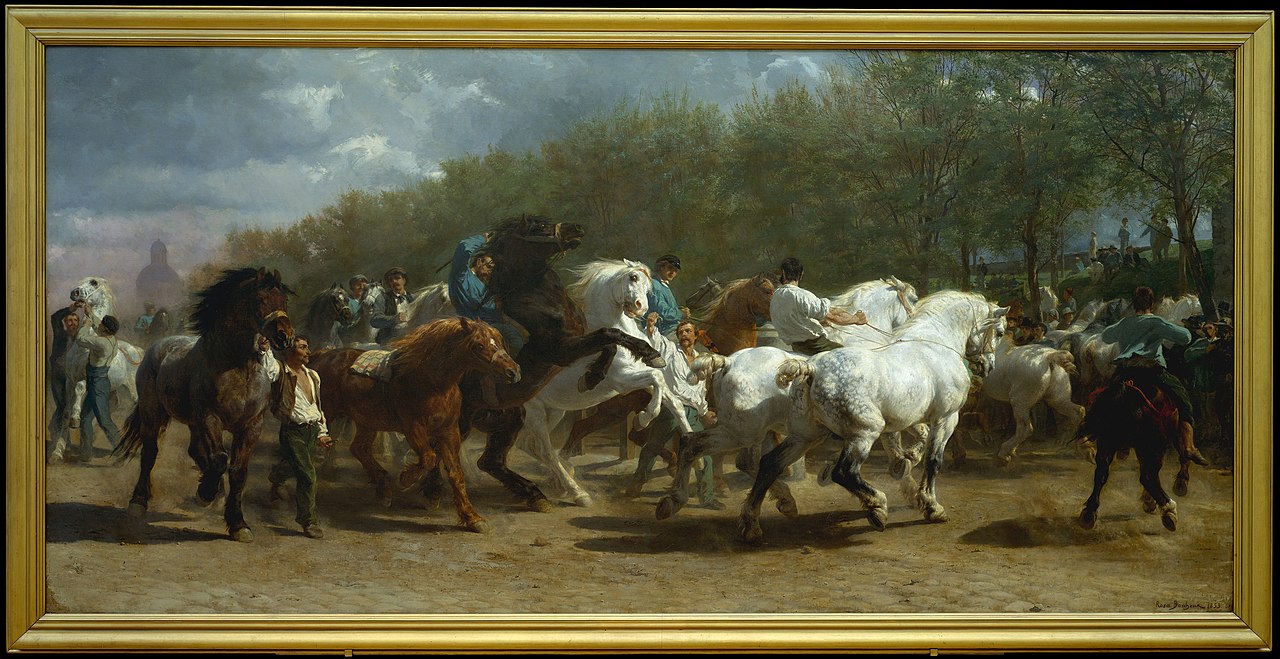
The painting was a sensation, and it traveled — it ended up across the Atlantic, given in 1887 by the American railroad heir Cornelius Vanderbilt II to the Metropolitan Museum of Art in New York, where it still hangs. A movement that began as a French quarrel with a French jury had, in this one giant canvas, become a thing Americans crossed an ocean to own.
Agency, not anecdote
There is a famous story about how Bonheur got into those markets at all. To sketch the horse fair unbothered — a woman alone in a rough, male, working crowd — she obtained, by her own record, an official police permit to wear men’s clothing, the trousers and smock that let her move through the market without being stared at or harassed. The detail is repeated everywhere, and it is genuinely useful, because it makes plain a thing that is otherwise easy to miss: the obstacles Bonheur cleared to do her work were not the obstacles a Courbet or a Daumier faced.
The substance behind it is not in doubt. Bonheur lived openly on her own terms, ran her own household and career, dressed for the work she meant to do, and built one of the most successful artistic lives of her century — sharing it with her lifelong companion Nathalie Micas, who ran the household and business side of things and so freed Bonheur to paint — without a patron’s leash or the official school that had refused to admit women at all. She is not a footnote to a movement of men. She is one of the people who proved the movement could win an audience — and she won a bigger one than most of them.
From the real to the seen
So where does Realism go? It does not so much end as graduate. By around 1870 its central permission had been granted and could not be taken back: ordinary, contemporary, unglamorous life was now a fit subject for serious art, at any scale a painter dared. The fight Courbet picked, Millet deepened, Daumier sharpened and Bonheur popularized had been, on that point, won.
The next generation took the permission and pushed it one step further. The Realists had said: paint the real world, the thing that is actually there. A circle of younger painters — boating parties and railway stations rather than gleaners and horse fairs, with Édouard Manet (the Olympia scandal-maker of the previous chapter) standing in the doorway between the two generations — would soon say something subtler: paint not the thing that is there, but the thing you actually see, the flicker of light on it in a single passing moment. That is the move from Realism to Impressionism, and it is less a break than a relay (the Impressionists get their own telling, one chapter along in the era overview). Courbet had thrown the door open by insisting the present was worth painting. The Impressionists walked through it and started painting the light.
Its leader did not get a soft landing. Realism’s politics caught up with the man who had made it a banner. In the Paris Commune of 1871 — the radical city government that seized Paris for ten weeks after France’s defeat by Prussia — Courbet helped pull down the Vendôme Column, Napoleon’s bronze victory monument, as a symbol of empire and war. When the Commune was crushed, he was convicted: six months in prison and a 500-franc fine. Then, in 1873, the State went further and ordered him to pay for the column’s reconstruction — an estimated 323,000 francs, to be handed over in yearly installments for the rest of his life. He fled to Switzerland and died there in exile in 1877. The man who had spent his career painting labor and the people paid, in the end, for his politics.
Realism was the first shot of the whole modern revolt — the moment a group of painters decided that their own ordinary century, exactly as it was, deserved the wall the gods had always hung on. Everything restless that follows in this era is, in some sense, still answering Courbet’s flat instruction: paint your own epoch, as it actually is.