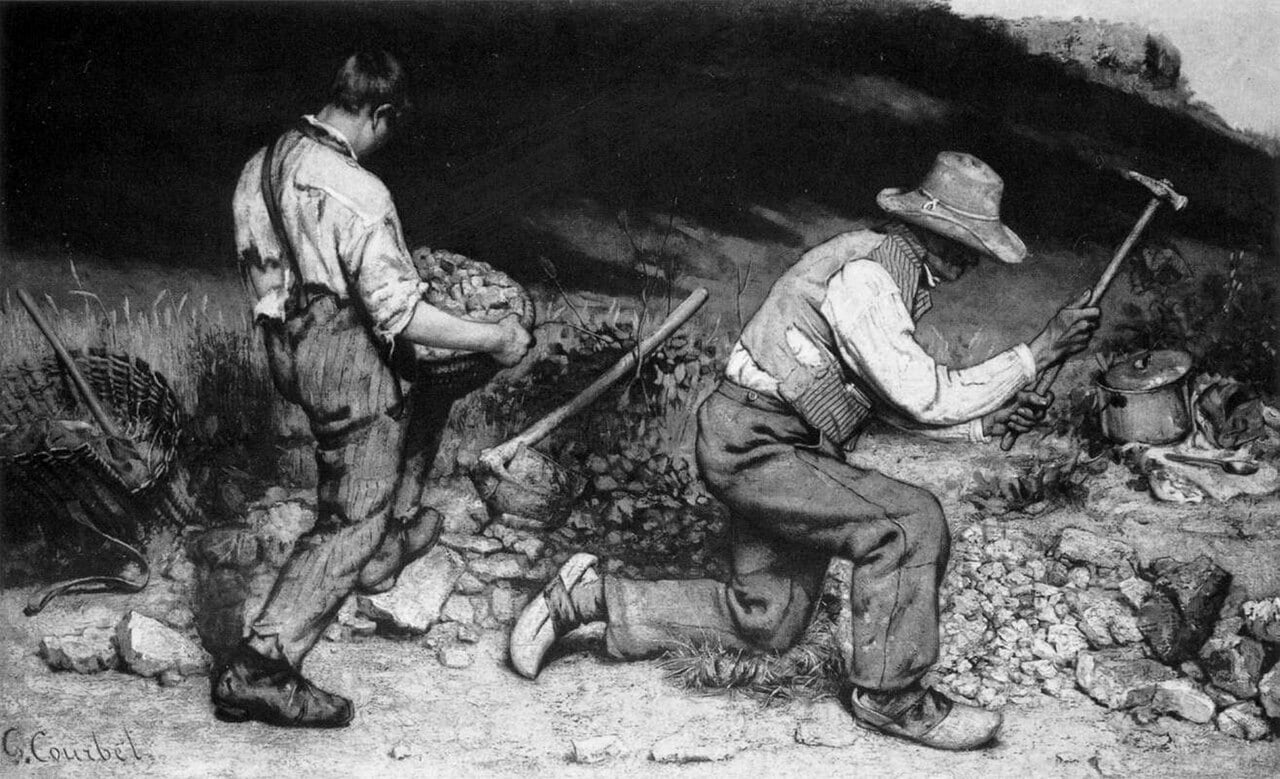
Around 1848 a handful of painters made a deliberate movement out of an almost rude idea: paint the real, ordinary, contemporary world — laborers, peasants, the urban poor — at the size and seriousness the academy had always reserved for myth and kings. It was the first shot in the whole modern revolt, and everything restless that follows is still answering it.
For two centuries French painting ran on a ladder. At the top: history and myth — gods, heroes, saints, kings. At the bottom: ordinary life. The Salon, the one official show that made or broke a career, rewarded the top of the ladder polished to a porcelain shine. Cabanel’s Venus is the perfect specimen — a flawless nude floating on a decorative wave, every brushstroke sanded away, the eroticism made respectable by calling her a goddess. The Emperor hung it in his own collection.
Courbet took the giant canvas size that the academy reserved for the death of a hero and spent it on a village funeral. No goddess, no allegory, no heaven opening overhead — just his own provincial neighbors in mud-black mourning clothes, ringed around an open grave, the paint laid on thick with brush and palette knife so you can see and almost feel every stroke. The faces are plain. The dog is bored. Nothing is idealized.
That is the whole argument of Realism, and it is why it counts as a new movement rather than a new style: the present — ordinary, unbeautiful, contemporary — deserves the scale and seriousness art had always saved for myth. Cabanel and Courbet hung in the same Paris a few years apart, and they are on opposite planets. The break wasn’t a new brush or a new color. It was throwing out the ladder.
“The title of Realist was thrust upon me just as the title of Romantic was imposed upon the men of 1830.”
“To be in a position to translate the customs, the ideas, the appearance of my epoch, according to my own estimation; to be not only a painter, but a man as well; in short, to create living art — this is my goal.”
Realism’s manifesto is not a sheet with a dozen signatures. It is a single page Courbet wrote to hand out at the door of his own tent — the Pavilion of Realism he threw up beside the 1855 world’s fair after its jury rejected his two biggest canvases (the Painter’s Studio and the Burial). A manifesto smuggled in as an exhibition catalogue.
What it claims is the whole movement in miniature: he did not pick the label, he accepted it; and his one aim is to paint his own century exactly as he finds it — its people, its manners, its look — with no gods borrowed from myth and nothing prettied up. Art made of the present tense. Living art.
A Burial at Ornans had already made that argument in paint five years earlier (its own read in this app); this page just says out loud what the ten-foot canvas had said in oil. The picture declared it first. The catalogue gave it words — and a name.