A weapon you could print
In 1832 a French artist went to prison for drawing a cartoon of the king. His name was Honoré Daumier (1808–1879), and the offending picture was a fat joke about a monarch’s appetite — but the State took it seriously enough to lock him up for it. That is the figure who drags Realism off the farm and into the modern city. Where Courbet gave us stone and graves and Millet gave us fields, Daumier gave us the present-tense town: its crowds, its politicians, its poor. And he did it first not with paint but with the printing press.
Daumier worked for the satirical newspapers of Paris as a caricaturist — an artist who exaggerates a public figure’s features and bearing to mock and expose them — and his weapon was lithography, a then-new printing method in which the artist draws directly onto a flat stone with a greasy crayon; the stone is inked, and hundreds of identical copies pull off it. Lithography is what made political cartooning a mass medium: it was fast, cheap, and it put the same biting image into thousands of hands at once. Daumier was its master. Over his life he produced thousands of lithographs for the press, skewering the kings, ministers, lawyers and self-satisfied bourgeois of his day with a savage, knowing line. It is Realism’s other half — not the dignity of the poor but the satire of the powerful, both aimed at the same target: the actual society in front of him, right now.
The cartoon that went to jail
Satire that lands hard tends to get the satirist in trouble, and Daumier’s did. In late 1831 he drew the reigning king, Louis-Philippe, as Gargantua — a grotesque giant, named for the gluttonous giant of a famous sixteenth-century French novel, enthroned and gorging himself on the taxes and tribute of his starving subjects, who haul wealth up a ramp into his enormous mouth while he excretes honors and favors out the other end onto the courtiers below. It was funny, it was filthy, and it was unmistakably the king. He was prosecuted the next year and jailed by 1832 — by the standard account, for around six months. (The story is told so often that the exact term is worth a beat of caution: take the six-month figure as the usual account rather than a fact carved in stone.)
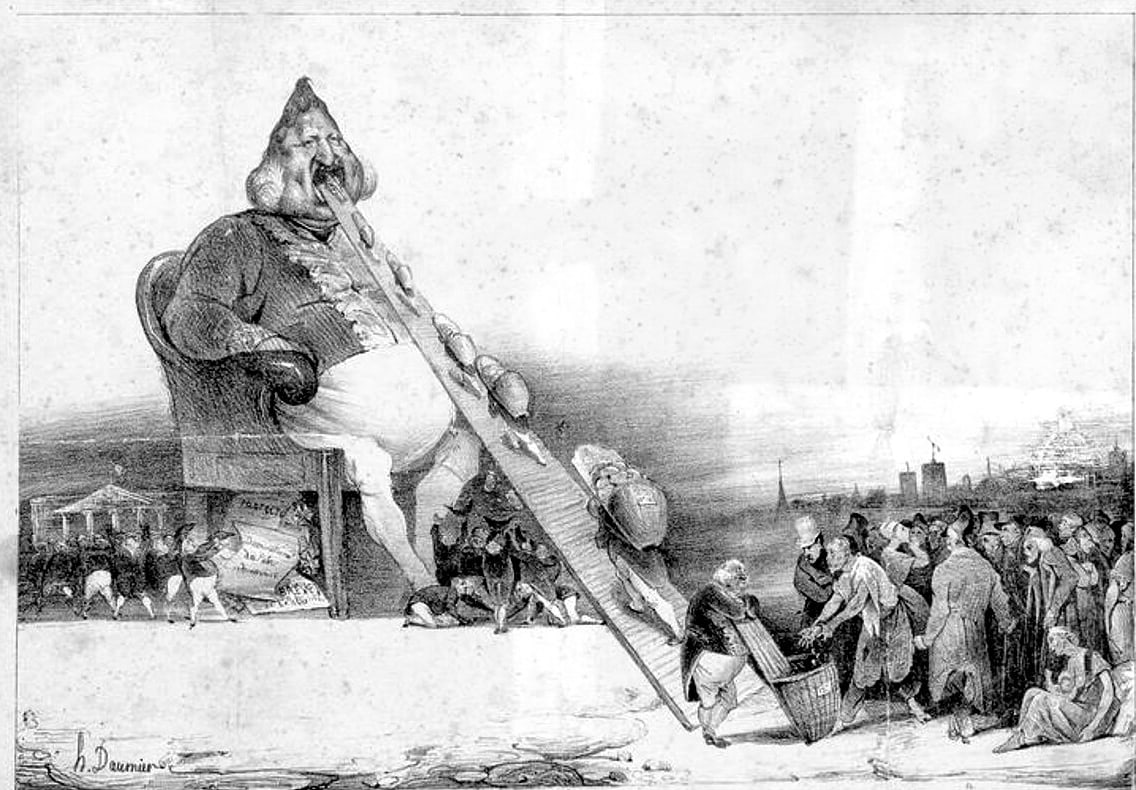
What is not in doubt is the principle the episode hands the rest of the era: an image can be dangerous enough to imprison a man for. The avant-garde’s later scandals — the riots at the Salon des Refusés (the overflow show of rejected pictures), the umbrellas raised against Édouard Manet’s Olympia (the modern painter’s notorious nude, who stared straight back at the viewer) — are usually about taste. Daumier got jailed over power. His Realism had teeth, and the State felt them.
The modern poor, packed in a box
Daumier painted, too, though far fewer people saw his canvases than saw his cartoons in his lifetime, and his greatest painting is the one that drags Realism fully into the machine age. The Third-Class Carriage (about 1862–1864, and left unfinished) shows the inside of a railway car’s cheapest class — third class, the bare-bench compartment of the people who could afford no better — packed with the urban poor on the move.
Look at who he gives the front bench. A nursing mother holds her baby; an old woman beside her sits folded over a basket, hands clasped, staring at nothing; a small boy has fallen asleep against them. Behind, rows of anonymous heads recede into the dim, jostling car. There is no event, no story, no drama — just the ordinary, exhausted, anonymous experience of being poor in a modern city, riding the new technology that the prosperous rode in better seats up the train. And there is no sentimentality, which is the Realist part: Daumier does not ask you to weep for these people, only to look at them. The faces are tired, dignified, unidealized, lit by the gray light coming through the carriage windows. The railway — the single most modern thing in their world — becomes a frame for the oldest subject there is, which is simply being poor.
That is the full reach of Realism in one canvas: the present tense, the modern machine, the ordinary poor, taken seriously and prettified not at all.
