A late start, a brother
The hardest fact about Van Gogh, the one the romance always blurs, is how late he started. Vincent van Gogh was born in Zundert (a village in the southern Netherlands) on 30 March 1853, the eldest son of a Dutch Reformed pastor. He did not begin to paint seriously until 1881, when he was 28. He died nine years and four months later, at 37 — a career shorter than a college sports star’s.
He had tried to be an art dealer at Goupil & Cie (1869–1876), fired for temperament; and a lay preacher in the Borinage coal-mining district of southern Belgium, dismissed for “excessive zeal.” His younger brother Theo van Gogh (1857–1891), by the 1880s a dealer in Paris at Boussod, Valadon & Cie, sent him money every month from the late 1870s until Vincent’s death. Without Theo there is no painter Van Gogh.
Vincent spent his first five years painting peasants in muddy browns — The Potato Eaters (1885, Van Gogh Museum) the most famous. The colors are Rembrandt’s. In March 1886 he moved to Paris, into Theo’s apartment on the rue Lepic in Montmartre, and met the Impressionists.
A color education and a yellow house
Paris was a two-year color crash course. He saw the Impressionists at the 8th show (Chapter 1), met Pissarro and Toulouse-Lautrec, papered Theo’s apartment with Japanese prints, and abandoned the muddy palette. He painted nearly 200 canvases in those Paris months and wore his brother out.
By February 1888 he had had enough of Paris and got on a train south. He stepped off in Arles, looking, he wrote, for “the Japan of the south.” In May he rented half a small two-story building at 2 place Lamartine: the Yellow House, painted yellow with green shutters. He painted his bedroom (first version of Bedroom in Arles, October 1888, Van Gogh Museum; about 2 ft 4½ in × 3 ft 0 in) in lemon yellow, cobalt blue and brick red. And he painted the sunflowers — fifteen giant single-stalked sunflowers in a yellow vase against a yellow wall (National Gallery, London; F.454, August 1888) — as decoration for the spare bedroom he was preparing for Paul Gauguin (Chapter 5), who arrived broke on 23 October 1888.
Nine weeks, two painters, one ear
What followed was nine weeks of co-habitation that destroyed the friendship and produced, partly out of adrenal terror, some of the best work either painter ever made. They argued constantly — Gauguin wanted Van Gogh to paint from memory, Van Gogh hated it; they drank absinthe. By mid-December they were screaming at each other.
The night of 23 December 1888 is the famous one. The exact sequence is debated, but the broad shape is documented: there was a quarrel; Gauguin walked out intending to spend the night at a hotel; Vincent followed him into the street, possibly with a razor; Gauguin scared him off; Vincent went home and, in the bathroom, cut off the lower lobe of his left ear (not the whole ear; an inch or so of flesh from the lower auricle). He wrapped it in newspaper, walked it down to a brothel he frequented, and gave it to one of the women working there (known in the records as Rachel), asking her to “keep this object carefully.” He passed out from blood loss and was found the next morning. Gauguin telegraphed Theo and left town.
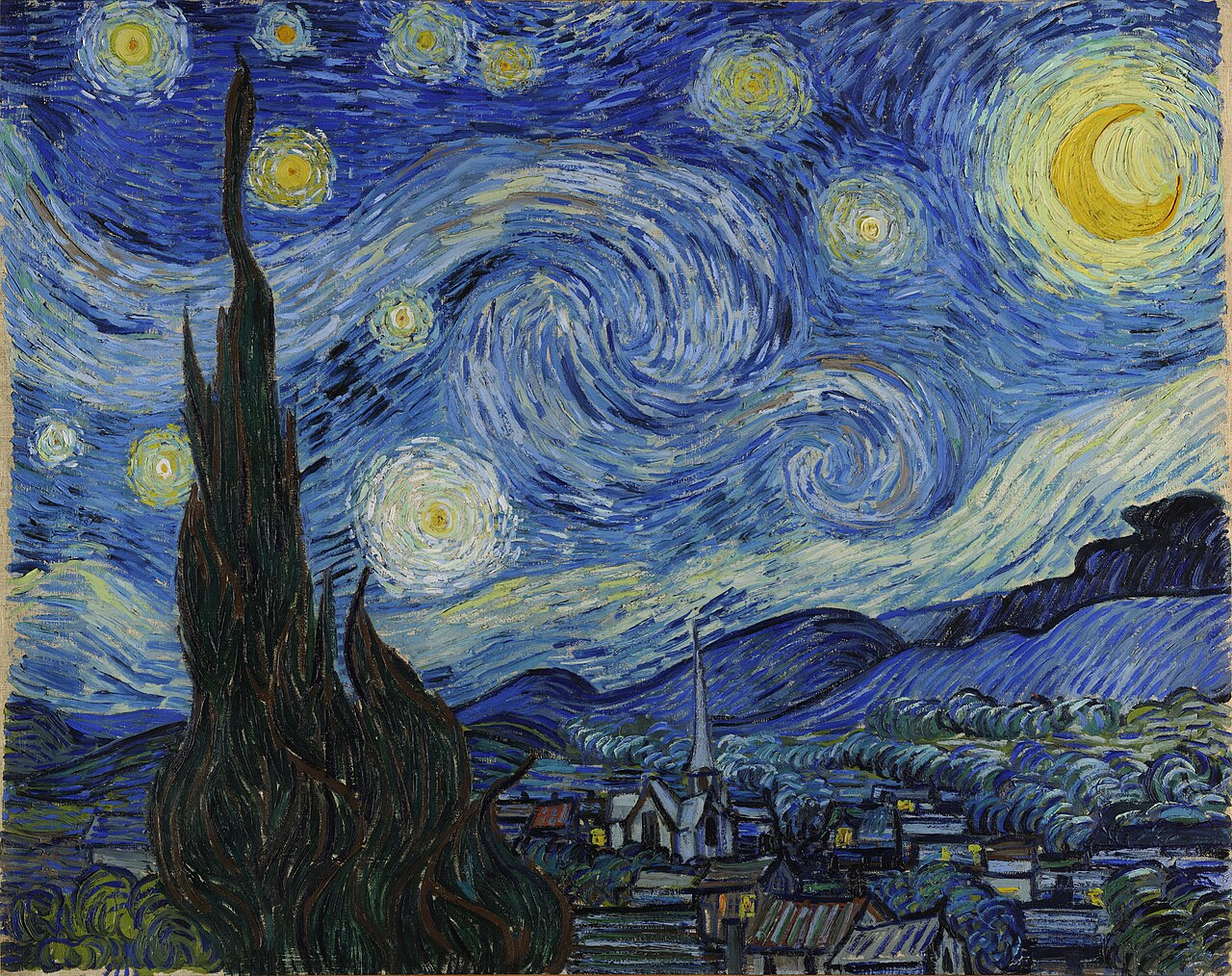
In May 1889 Vincent voluntarily admitted himself to the asylum at Saint-Paul-de-Mausole, in Saint-Rémy-de-Provence, and stayed a year. He was permitted to paint. He produced, during that year, some of his most famous canvases — including The Starry Night, painted in June 1889 from memory and the view out his barred east-facing window (MoMA, New York; about 2 ft 5 in × 3 ft 0¼ in). It is the most reproduced picture in Western art after the Mona Lisa, and Van Gogh painted it locked up. The work was made in spite of the suffering, not because of it; the madness-genius myth gets the arrow exactly backward.
The wheatfield and the gun
In May 1890 he left Saint-Rémy and travelled about twenty miles north of Paris to Auvers-sur-Oise, under the care of Dr Paul Gachet, a homeopathic physician who painted on the side. (Van Gogh’s Portrait of Dr Gachet sold at Christie’s New York in 1990 for $82.5 million — for years the auction record for an Impressionist or Post-Impressionist work.) He painted Auvers in a frenzy — the town church, the wheatfields, Wheatfield with Crows (Van Gogh Museum), a roiling blue-black sky with a flock of crows lifting off.
On the afternoon of Sunday, 27 July 1890, Van Gogh walked out into a field near Auvers and shot himself in the chest with a small revolver. The shot did not kill him. He staggered back to the Auberge Ravoux, the inn where he was lodging. Two doctors couldn’t get at the bullet. Theo arrived the next morning. Vincent died around 1:30 a.m. on 29 July 1890, with Theo at his side. He was 37. Theo reported his last words to their mother as “La tristesse durera toujours” — “the sadness will last forever.” (One hedge: in 2011 the biographers Naifeh and Smith argued he was shot by a local boy, not by his own hand; the Van Gogh Museum still treats it as suicide.)
Theo died six months later, on 25 January 1891, age 33, of complications from syphilis. His wife Jo was left with a one-year-old baby (also named Vincent), hundreds of Vincent’s letters, and most of the unsold paintings. She spent the rest of her life building Vincent’s posthumous reputation; she is the reason the Van Gogh Museum exists. Vincent sold one painting in life at a real price — The Red Vineyard, bought by the Belgian painter Anna Boch for 400 francs at Les XX in Brussels in early 1890. He painted around 900 canvases. Within twenty years his pictures would be the most fought-over canvases in Europe.