The crash, the wife, the leap
Paul Gauguin was born in Paris on 7 June 1848, son of a French journalist father and a Peruvian-French mother. When he was 1, the family sailed for Peru; his father died en route. The boy grew up in Lima until he was 7 — that early displacement matters; he never quite settled back into being French.
By his 20s he was a Parisian stockbroker, good at it. In 1873 he married Mette-Sophie Gad, a Danish woman; they had five children between 1874 and 1883. Then in 1882 the Paris stock market crashed (the krach de l’Union générale) and Gauguin lost his job. He took it as a sign. He moved the family to Copenhagen in 1884; the Danish in-laws found him impossible. By 1885 he had walked out of the marriage and returned to Paris alone. He never lived with his wife and children again.
There is no charitable way to tell this part. Gauguin was not poor in 1885 the way Van Gogh was poor. He was a man with a wife and five small children whom he chose to leave so that he could be a painter. The art does not exist without that decision. The decision is part of the art’s price.
Brittany, Bernard, and a red field
In summer 1888 Gauguin came back to Pont-Aven, a small Brittany village that had become a painters’ colony (low pension rates, local women still in picturesque starched bonnets), this time with a clear program. He met a younger painter named Émile Bernard (19, theoretically minded), and they began working out Synthetism (sometimes cloisonnisme, after the cloisonné enamels the technique visually resembled): paintings built of large flat areas of saturated color, separated by hard dark contour lines, with depth and modeling cut out. The picture was no longer a window onto a real scene; it was an arrangement of color areas, designed for emotional or symbolic effect.
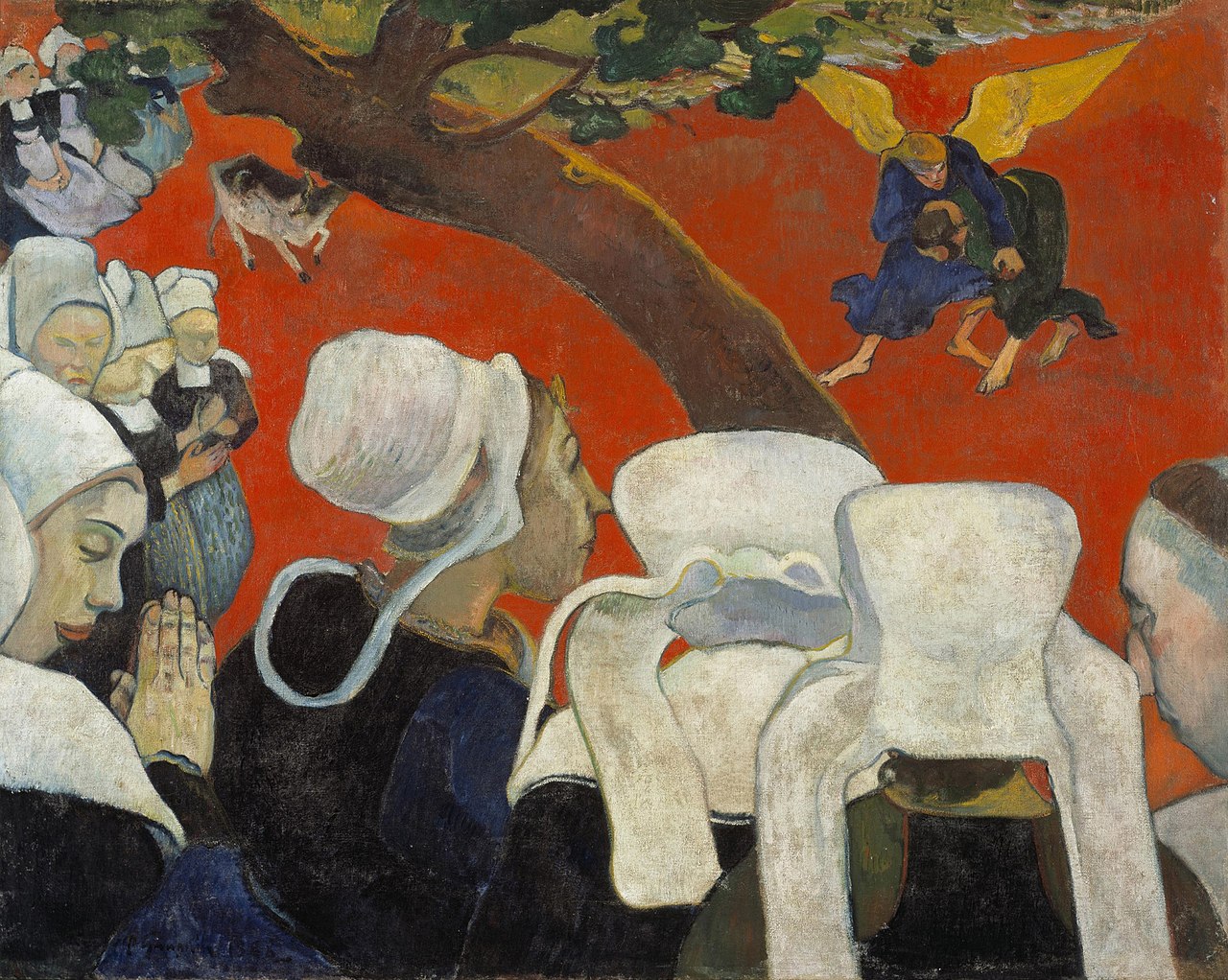
The picture that demonstrates the move is Vision after the Sermon (Jacob Wrestling with the Angel), autumn 1888 (Scottish National Gallery, Edinburgh; about 2 ft 4½ in × 3 ft 0 in). In the lower half, Breton peasant women in starched bonnets are coming out of mass; they have just heard the sermon about Jacob wrestling the angel. Their eyes are closed in something between prayer and exhaustion. In the upper half, separated from the women by the diagonal tree (often read as an apple tree, after Eden) slicing the canvas, Jacob and the angel are actually visible in the act of wrestling, against a field of pure flat red — the kind of red a child reaches for first in a paint box.
Where is the wrestling really happening? Not in the field. It is in the minds of the Breton women, who heard the sermon, closed their eyes, and imagined it. The painter has put the inside of their imagination on the canvas as a separate zone. The whole machinery of “a picture as a window” is dismantled. What you are looking at is meaning, painted directly. (Gauguin tried to give the canvas to the parish church; the priest refused — he could see the picture was about the women, not about Jacob.)
Forwarded to Chapter 4
The nine weeks at the Yellow House are Chapter 4’s territory. Briefly: Gauguin came south because he was broke; Theo van Gogh would stipend him for going; Vincent had been pleading. The visit went badly. Vincent cut off the lower lobe of his left ear on 23 December and Gauguin left two days later. What Gauguin took from Arles, beyond the trauma, was the confirmation that his future was not in France. He went back to Paris with the idea, now hardening, that he would go somewhere very far away.
The boat to Tahiti
On 1 April 1891 Gauguin sailed from Marseille for Tahiti, arriving in Papeete on 9 June. He had told the friends who saw him off — the Symbolist writers Mallarmé and Charles Morice — that he was going to find a primitive, pre-Christian paradise where he could paint untouched by European convention. He was exporting a French romance of the primitif about as far as it could go.
What he was actually doing was sailing into a French colony. Tahiti had been a French protectorate since 1842 and a formal colony since 1880. Papeete had cathedrals, gendarmes, French administrators, French missionaries, French gunboats. The surviving Tahitians lived under colonial rule, paid colonial taxes, and were mostly Catholic. Gauguin’s primitive Tahiti was a fantasy he carried in his luggage; the real Tahiti was a French outpost where colonial police came round when he made trouble.
He painted there anyway, and what he painted was extraordinary — the saturated, flat-color, dreamlike Tahitian pictures we now know him by: Manaò tupapaú (Spirit of the Dead Watching), 1892 (Buffalo AKG Art Museum), a young Tahitian girl lying face-down on a bed under a yellow blanket, watched by a dark spirit-figure; Where Do We Come From? What Are We? Where Are We Going?, 1897–98 (Museum of Fine Arts, Boston; about 4 ft 6½ in × 12 ft 3½ in), a long horizontal mural Gauguin painted as his testament before attempting suicide with arsenic in late 1897 (he survived). It reads right-to-left: a baby on the right, an adult reaching for a fruit in the center, an old woman on the left. Birth, life, death.
The colonial question, in plain language
The part of Gauguin’s story that 21st-century writing cannot skim past, and that earlier 20th-century writing did.
In Tahiti and later in the Marquesas, Gauguin lived with three successive Polynesian girls, all adolescents: Teha’amana (in Tahiti, from 1892, traditionally said to have been 13 when he took her into his house; uncertain but certainly a child); Pau’ura a Tai (in Tahiti, around 14 when their relationship began in 1896); and Vaeoho Marie-Rose (in the Marquesas, around 14 when she moved in with him in 1901). He had children by at least two of them. He referred to all three as his “wives” in his journals.
It is important not to project 21st-century legal categories backward without thinking — adolescent marriage was legal and common in late-19th-century France and across French colonial territory — and it is also important not to use that context to disappear what these relationships actually were. Gauguin was a European man in his 40s using colonial power and money to set up sexual partnerships with Polynesian girls who could not, by any honest reading, have refused him on equal terms. Several of his greatest paintings — Manaò tupapaú among them — depict these girls. The pictures will not be undone; but a serious account of Gauguin cannot pretend the biography is just colorful.
He had advanced syphilis by his last years and spent his last decade in pain. In September 1901 he moved to Hiva Oa in the Marquesas and built himself a wooden house he called the Maison du Jouir (“House of Pleasure”), carved with sculpted nudes around the doorway. He wrote pamphlets attacking the colonial authorities for their treatment of the Polynesians, which is to his credit, while continuing his exploitation of Polynesian girls, which is not.
He died on 8 May 1903 on Hiva Oa, age 54, of a heart attack while taking morphine for the syphilis pain. The French Catholic bishop, with whom he had been feuding bitterly, buried him in the local cemetery. His pictures were auctioned cheap on Tahiti the following autumn. Within fifteen years they would be unaffordable in any market on earth.