Start at the top
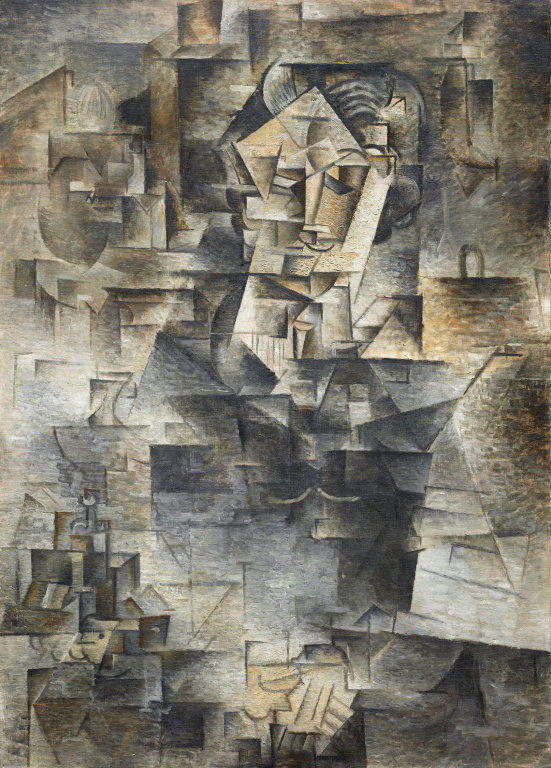
At first glance it is a gray-brown avalanche of broken planes, and it is tempting to give up. Don’t — there is a man in here, and finding him is the whole pleasure. Start at the very top. That patch of fine diagonal hatching, almost like wood grain, is hair: wavy, carefully combed, parted on one side. It is the easiest foothold, so plant your feet there first.
Drop down a little and a face assembles itself out of the rubble — two dark almond eyes, the ridge of a nose, the line of a brow. Below them, a thin dark mustache sits over the mouth. Keep going down the center and you reach the throat, where Picasso has left two of the clearest clues in the whole painting: the neat triangle of a tie knot, and, swagging across the waistcoat, the little chain of a pocket watch. Those two ordinary gentleman’s details are the painting telling you, quietly, that this scaffold is a person, dressed for business.
Now the bottom. A cluster of pale interlocking blocks resolves into a pair of clasped hands, folded in his lap. And off to the lower left of the canvas — which is the sitter’s right side, since he faces you — sit the shards of a small still life: a bottle, and most likely a glass beside it. So Picasso pins the figure down top and bottom — hair up here, hands down there, watch chain anchoring the middle — and lets everything between explode into facets.
Why it stops short
Here is the thing people miss: this is not abstract art. Picasso could have dissolved Kahnweiler into pure pattern and walked away — and he chose not to. Analytic Cubism deliberately keeps a tether to the real world: just enough hair, eye, mustache, tie, watch chain and bottle that a patient viewer can climb back to a man. The painting’s whole charge lives in that tension — a face on the knife-edge of vanishing, held back from the drop by five or six clues a stubborn eye can still find.