Roped together
“It was like being roped together on a mountain,” Braque said later, looking back on these years. He meant it the way a climber means it: one slip and you both go off the cliff, so you watch each other’s every move. He and Picasso both lived on the Montmartre hill in northern Paris — Picasso in the rickety studio block called the Bateau-Lavoir — and through 1909, 1910 and 1911 they went round to each other’s studios nearly every day, eyeing what the other had done since yesterday and pushing the same problem one more inch.
They worked so much in lockstep that, for a stretch, they stopped signing the fronts of their canvases — you had to flip a picture over to learn whose it was. The result is that even now, more than a century on, scholars sometimes can’t agree on which man painted which canvas. Two people had effectively merged into one painter.
A face from every side at once
What they invented in those rope-together years is called Analytic Cubism (roughly 1909–1911). The idea: take an object — a violin, a bottle, a head — and shatter it into small flat facets, the little angled planes you see on the cut surface of a gem, then lay those facets out on the canvas as if you were seeing the thing from several sides at the same moment. And do all this in a deliberately drab, near-colourless range of browns, grays and ochres (the dull yellow-brown of dried clay). The color is drained out on purpose: with nothing pretty to look at, your eye is forced onto the only thing left — the structure.
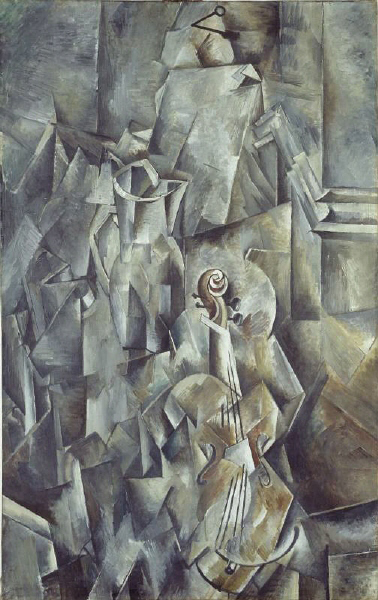
And it really was the same year, the same problem, the same drab palette — two men, one experiment. Set Braque’s pitcher beside what Picasso was doing with a human figure that summer and the kinship is almost embarrassing.

Borrowed from a mask
The strangest move — showing a thing from several angles at once — was not invented in Montmartre. Picasso had met it in 1907, in the African masks crammed into the ethnographic museum at the Trocadéro in Paris. A carved Fang or Kota mask from Central Africa already did the impossible thing: it showed a face dead-on and in profile in the same object, nose and brow and cheek read at once. The African carvers had solved “several views in one image” long before any Frenchman thought of it. Cubism took that solution and ran. It is worth saying plainly, because the textbooks usually don’t: the central trick of the most influential painting movement of the century was borrowed, uncredited, from anonymous African sculptors.
To the edge of legibility
By 1910 the method had pushed so far that the pictures were nearly impossible to read — a few more facets and the subject would dissolve into pure pattern. That scared even Picasso and Braque, so over these years they began smuggling clues back in: the curl of a clarinet, a stencilled letter, a painted nail so real it fools the eye. The Kahnweiler portrait sits right on that edge — but turned, for once, on a living man instead of a jug. A human being taken to the brink of vanishing, then yanked back to earth by a handful of things you can still name.