Late spring, 1863
In May of 1863, Robert E. Lee (South) did something his army had never done. He decided to invade the United States.
He was doing it from the high-water mark of his career. About a month earlier, at Chancellorsville in Virginia, Lee had attacked a Union army roughly twice the size of his own and beaten it badly — the kind of victory that makes a general feel briefly invincible and gets very dangerous ideas taken seriously. Instead of waiting in worn-out Virginia for the next blow to fall, Lee proposed marching the Army of Northern Virginia the other way: north, across the Potomac River, into Pennsylvania, onto Northern ground.
The reasons were real and they were many, which is part of why it was so hard to argue him out of it. Virginia had been the war’s battlefield for two years and had been picked clean; an army that lived off the land needed land that still had something on it, and Pennsylvania’s farms were fat with the summer’s grain and cattle. A Confederate army loose in the North might draw Union troops away from Vicksburg, the river fortress hundreds of miles to the southwest that Ulysses S. Grant (North) was slowly strangling. It might frighten Northern voters and Northern bankers. It might, if Lee won a big enough victory on Northern soil, finally push Britain or France to recognize the Confederacy as a country — to treat the South as a real nation instead of a rebellion, with everything that came with it: trade, money, maybe even help.
That was the whole, honest case. It was not, as the legend later had it, an army gone shopping. Lee was reaching for the things that win wars without being battles.
They left for the North on June 3rd.
Three states, and what the army carried
Lee took his army up the Shenandoah Valley, the long green corridor running northeast through Virginia toward Pennsylvania, the same valley Stonewall Jackson (South) had marched up and down until weeks before, when he was shot by his own men at Chancellorsville and died of it. By the third week of June the Army of Northern Virginia was loose in Pennsylvania — better than seventy thousand men spread across miles of farm country, taking what they needed and, by Lee’s strict orders, trying not to burn or wreck what they didn’t. This was supposed to be the army that proved the South could be a nation. Nations don’t sack the countryside; that was the theory, anyway.
It was not the whole of what the army did, and the rest is harder to look at squarely. The Confederacy was fighting to keep human beings as property, and as it marched north it carried that war aim with it in the most literal way there is. Acting under orders sent from Richmond that spring about “fugitive slaves,” the cavalry riding in front of the army — Brig. Gen. Albert Jenkins’s (South) Virginia horsemen, and others — seized free Black people across Maryland and Pennsylvania and sent them south into slavery. Not a handful. Hundreds: men, women, and children, swept up out of towns like Mercersburg and Chambersburg and the country around Gettysburg, many of them free-born people who had never been enslaved at all. A soldier in the 4th Georgia (South) wrote home, plainly and without shame, that the army had “captured… over a hundred negroes.” The army that had come north to win a country built on slavery brought slavery north with it, in chains, on the same roads as the grain and the cattle.
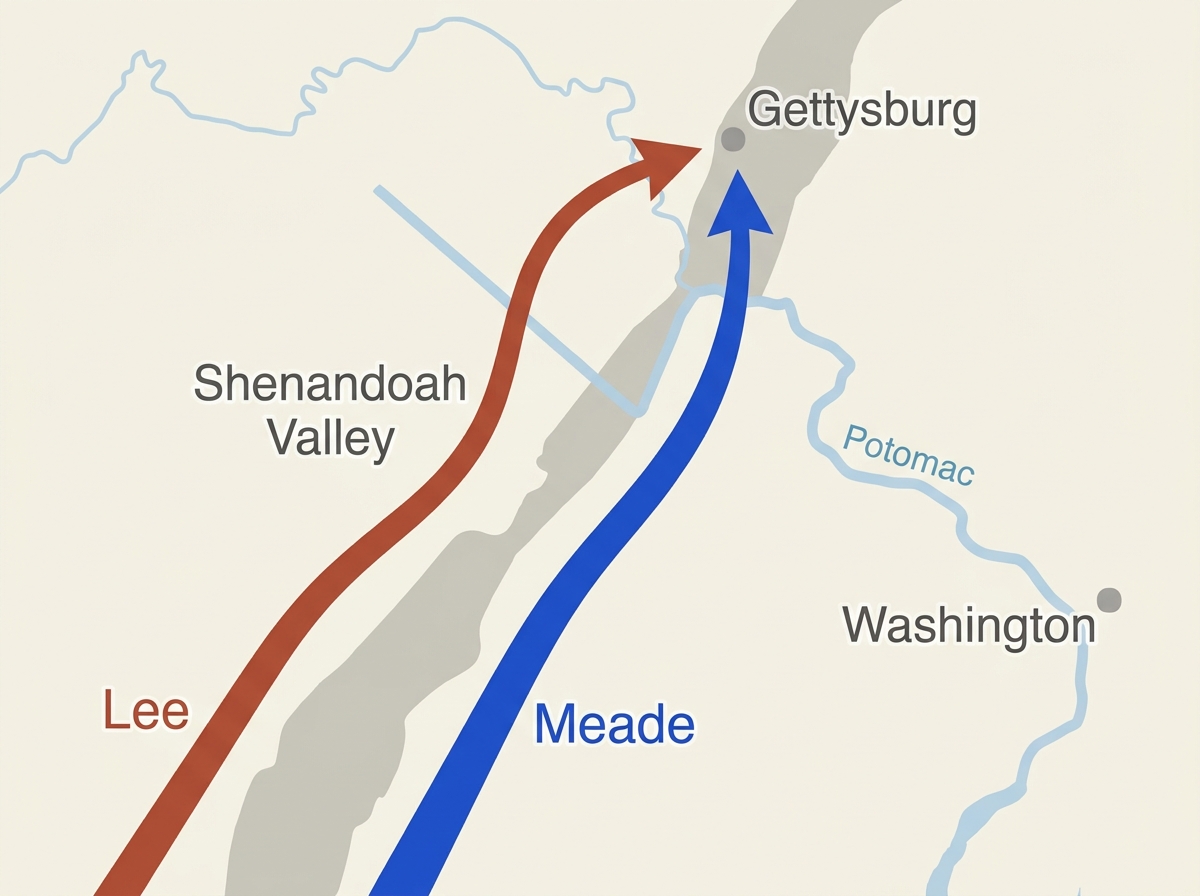
Trailing him, on the eastern side of the mountains, came the Army of the Potomac — the United States’ main army in the East — under Maj. Gen. Joseph Hooker (North). It moved slowly and argued with Washington the whole way. Hooker had been the loser at Chancellorsville, his confidence was gone, and his superiors had stopped trusting him. On June 28th, three days before the battle, the feud ended the only way it could: Hooker resigned.
He was replaced overnight by one of his own corps commanders (a corps is a large self-contained chunk of an army, tens of thousands of men under a single general), a sober, reliable Pennsylvanian named George G. Meade (North). Meade had not asked for the job and had not been told he was even being considered. He took command three days before the largest battle of the war, in his own home state, with no clear idea where the enemy was.
A town with ten roads
That last part went both ways. Lee was just as blind. His cavalry — the army’s eyes, the horsemen who ride ahead and report where the enemy is and isn’t — was led by the flamboyant J.E.B. “Jeb” Stuart (South), and Stuart had taken it off on a long, glory-seeking ride clear around the Union army. For days, at the worst possible moment, Lee was marching an army through enemy country without being able to see. He did not know where the whole Army of the Potomac was, or that it was closing on him.
Nobody planned to fight at Gettysburg. It was a small market town in south-central Pennsylvania — roughly twenty-four hundred people in 1860, a Lutheran seminary, a college, nothing of any military value. What it had was roads. Ten of them came together there, radiating out like spokes from a wheel hub. In an age when armies moved at the speed of a walking man on a dirt road, a place where ten roads met was a place an army could reach fast, leave fast, and feed itself from in every direction. Whichever side got there first and held the high ground around it could make the other side do the attacking — uphill, across open fields, into prepared guns. That was the only thing Gettysburg was worth, and it turned out to be worth a great deal.
What ended Lee’s blindness was not a cavalry report. It was a spy. On the night of June 28th, a scout named Henry Thomas Harrison — a shabby, theatrical man working for Lt. Gen. James Longstreet (South) — walked into camp with the thing Lee had been missing for a week. The Union army, Harrison said, had crossed the Potomac into Maryland and was already moving north toward him, fast; and the man leading it was no longer Hooker but Meade. Lee had never much trusted Harrison. This time he believed him, because he had nothing else, and because it fit the cold feeling that he had let the enemy get too close. He gave the order to pull his scattered army together near Cashtown, a village about eight miles west of a road hub called Gettysburg. Years later, looking back, Lee wrote that “a battle thus became, in a measure, unavoidable.” Two armies that had each been groping for the other in the dark were now reaching for the same patch of ground, and neither one fully knew it yet.
It would last three days, leave roughly fifty thousand men killed, wounded, or captured, and decide whether the Confederacy got to keep existing.