A man who picked his ground
The reason there was anything in Gettysburg to stop the Confederate army was one stubborn cavalry officer who had arrived the day before and decided, on his own, that this was the place.
John Buford (North) was a Union cavalry general (cavalry are soldiers who fight on horseback, used as scouts and fast-moving troops). He had ridden into Gettysburg on June 30th with about twenty-seven hundred troopers and looked at the ground the way Buford looked at ground: not for where to camp, but for where to fight. He saw the ridges west of town — low rises a defending line could hide behind and shoot from — and the roads the Confederates would have to come down to reach them. He saw what the whole battle would later prove: that this was good ground, and that the army holding it could force the other army to bleed for it. And he understood the one thing his cavalry could not change. He had a couple of thousand horsemen. Lee had seventy thousand men coming. Cavalry could not win here. It could only buy time — hold the ridges long enough for the Union infantry, still hours down the road to the south, to arrive and turn a delaying action into a battle.
Buford’s troopers had one advantage that mattered enormously for the next few hours: their weapons. They carried breech-loading carbines — short rifles that loaded at the back end (the breech), so a man could reload lying down and fire several shots in the time it took a Confederate infantryman to reload his muzzle-loading musket from the front. A dismounted cavalry line was thin, but for a few hours it could throw out fire as if it were thicker than it was. Buford spread his men along the ridges, told his officers the rebels would come at dawn, and waited for the morning to prove him right.
The first shots
Coming the other way down the Chambersburg Pike was Henry Heth’s (South) division — roughly seventy-six hundred Confederate infantry, far more men than Buford had. (A division is several brigades together, a brigade several regiments; in this war a division might run five to eight thousand men.) Heth’s move was a reconnaissance in force — a probe in strength to find the enemy, not the shoe-hunting raid of legend — and like Lee, Heth was half-blind. He had been told there might be local militia in the town. He did not believe veteran Union cavalry was anywhere near him, and he came on without enough caution.
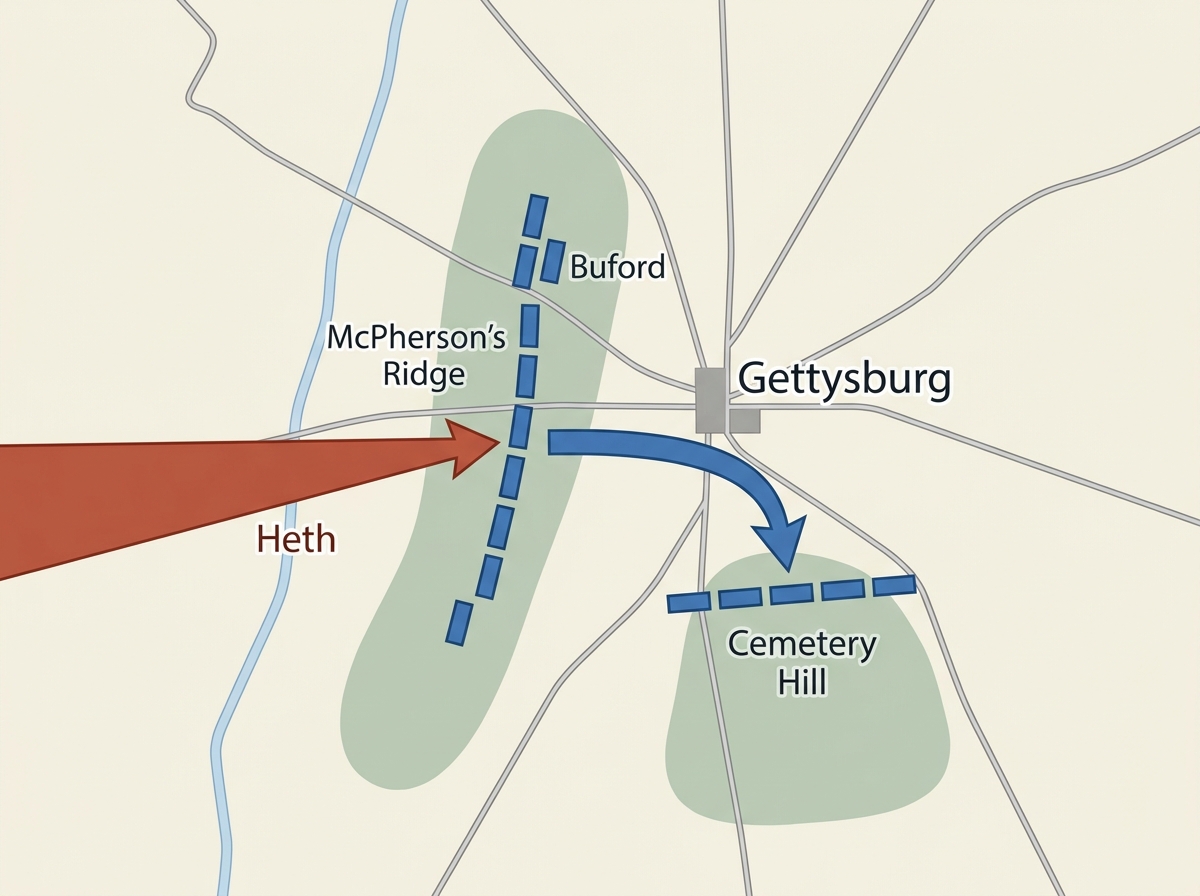
A little after seven in the morning, Buford’s pickets opened fire from behind a fence rail in the gray light. The shooting was uneven, then steadier, then unmistakable. Heth deployed for what he thought was a brush with militia and discovered, the hard and slow way, that he was fighting dug-in regulars who would not break and run. By the time he understood what he had walked into, he had committed himself — and through him, piece by piece, he was committing Lee — to a fight on ground the Confederate army had not chosen, started by an encounter no one above him had ordered. This is the strange engine of Gettysburg: a battle that grew from a collision, each side feeding in more men to support the men already fighting, until two armies that had been hunting each other in the dark were locked together and could not let go.
Reynolds, dead in the first hour
Buford’s cavalry held the ridges through the early morning, fighting and falling back, fighting and falling back, trading ground for the minutes the infantry needed. And then, near mid-morning, the infantry came.
At the head of it rode John F. Reynolds (North), the senior Union corps commander on the field and one of the most respected soldiers in the army. Reynolds saw what Buford had been holding and decided it was worth holding. He hurried his I Corps forward into the fight himself, riding up close to the firing, personally shoving regiments into line — including the Iron Brigade, Indiana and Michigan and Wisconsin men who had earned their hard name at South Mountain the autumn before, for standing in a fight that should have broken them and not breaking.
He was placing those men at the edge of a stand of trees, turned in the saddle to look back for the rest of the corps coming up the road, when a bullet caught him behind the ear. He was dead before he hit the ground. It happened in the space of a sentence — one moment the general was pointing troops into the woods, the next he was a body being lifted off the field by men who could not quite take it in. The soldiers nearest him kept loading and firing for a while without knowing their general was gone, because there was no time to be told and nothing to be done if they had been. It was a little after ten in the morning. The most senior man who would die at Gettysburg was already dead, and the battle was barely three hours old. The day had not even begun to be terrible yet, and it had already taken the best soldier on the field.
Driven back through the town
For a while the Union held. Then the weight came on, and the day turned into the kind of thing the men who lived through it spent the rest of their lives not describing.
More and more of Lee’s army arrived faster than more of Meade’s could. Heth was reinforced by Pender’s division behind him; then, worse, fresh Confederate divisions under Rodes and Early came down from the north, folding the Union line in from a second direction at once. The outnumbered I and XI Corps — three divisions of the enemy converging on them from two ways — were now being shot at from the west and the north together, and there was no holding it. The line came apart, not all at once but in pieces, regiments giving way and the giving-way spreading.
Imagine being one of those men. You have been on your feet and under fire since mid-morning; the friend who stood at your shoulder is down and you stepped over him an hour ago; your officers are dead or shouting orders no one can follow; and now the order is to fall back — back the way you came, back across the same fields, except the fields are full of your own dead and dying now, the men you marched up with that morning, and the enemy is behind you and beside you and pouring fire into the crowd you have become. The retreat carried into the streets of Gettysburg itself, soldiers stumbling between the houses of a market town, through gardens and yards and alleys, the townspeople’s families pressed into cellars while two armies fought past their front steps. Order dissolved into a mob. Men got turned around in streets they had never seen, ran into walls and fences and each other, and were taken prisoner by the hundreds because there was nowhere left to run that the enemy was not already standing.
But there was high ground south of town. A long, low rise crowned by the town’s graveyard: Cemetery Hill. The broken Union corps fell back onto it and, for the first time all day, found themselves standing somewhere strong — somewhere a beaten army could plant its feet and dare the enemy to come up after it. The day had gone about as badly as a day could go. Where it ended was the one piece of luck in it.
Hancock holds the heights
Into that crumbling afternoon, Meade — still miles away, still not on the field — sent the one man he most trusted to think for him. Maj. Gen. Winfield Scott Hancock (North) rode ahead of the army with written authority to take command on the spot and decide a question no one else could: whether Gettysburg was a place to stand and fight at all, or whether the beaten Union army should pull back somewhere else entirely.
Hancock arrived after four in the afternoon, into a swirl of retreating men and rattled officers, and did what made him one of the great battlefield presences of the war: he steadied it. He rode the cemetery heights, took in the ridges and hills running south, and saw exactly what Buford had seen at dawn. This was ground worth an army. He began grabbing the broken corps and pushing them into a line along the high ground, and he sent word back to Meade that came down to a single decision — bring the whole army here, this is where we fight. Of the position he later said, plainly:
I think this the strongest position by nature upon which to fight a battle that I ever saw.
They dug in along the hills and the ridge in the failing light, scraping out a line on the high ground. What they were starting to build, though no one fighting in the dark could see it yet, would by morning curl across the heights in a long, hooked shape.
The hill Ewell didn’t take
Here is the part that men argued about for the next fifty years.
As the Union army streamed up onto Cemetery Hill in the dusk — beaten, disorganized, not yet dug in — it was, for a window of perhaps an hour or two, takeable. And on the Confederate side, the corps best placed to take it belonged to Lt. Gen. Richard Ewell (South), whose divisions had just rolled the Union line up from the north and were closest to the heights. Lee sent Ewell an order to take the hill if he could. Ewell looked at it — his men scattered and tired from a day of hard fighting, the light going, the Union gathering on the high ground in front of him — and judged that he could not, and did not attack. Overnight the Union dug in on that hill, and the next morning it was a fortress.
It became one of the great what-ifs of the war: the hill that lost the battle, the attack that never came. But the story most people have heard about it is a lie with a purpose, and it is worth knowing how the lie was made. The famous version says Lee ordered Ewell to take the hill “if practicable” and that the timid Ewell, frozen by the word, threw away the victory. That wording — “if practicable” — first surfaced in a report Lee revised and filed in January 1864, months after the fact. And the campaign to pin the lost battle on Ewell came mostly after Lee was dead, pushed hardest by another of Lee’s generals, Jubal Early (South), as part of what later got called the “Lost Cause” — the long postwar effort to recast the Confederacy’s defeat as the fault of underlings rather than of Lee or of the cause itself. The honest reading is duller and fairer: Lee gave a discretionary order, one that in the same breath told Ewell to avoid bringing on a general engagement before the rest of the army was up. Ewell, looking at exhausted men and a strengthening enemy in fading light, made a defensible call. He may have been wrong. He was not the villain the story needed him to be.
Lee, committed
A few miles west, on Seminary Ridge, Lee (South) rode up in the evening and looked east at what the day had made.
It was, in almost every way, the battle he had not wanted. He had not picked this town or this ground. He had stumbled into a full engagement before he was ready, still half-blind without Stuart’s cavalry, with his army strung out for miles and one of his three corps — Longstreet’s — still a hard day’s march from the field. His men had won the first day, driven the enemy through the streets, taken prisoners and ground. But the enemy he had driven was now dug in on high ground of their choosing, getting stronger by the hour as the rest of the Army of the Potomac marched through the night toward those hills.
The cautious move was the one Longstreet would press on him: break contact, slip away, and force Meade to come find him on ground Lee picked. But Lee had just won a day of fighting, his blood was up, his army believed it could beat these people anywhere, and turning away now would feel like throwing away a victory already half in hand. He looked at the Union line gathering on the heights, and he decided to take it from them.
He resolved to attack the next day.
On the hills south of Gettysburg, in the dark, ten thousand spades bit into the same ground, and a beaten army turned itself into a wall.