The morning after Day 1
At dawn on July 2nd, the Army of the Potomac woke up holding one of the strongest defensive positions any American army would ever occupy — and it had gotten there almost by accident, beaten backward onto it the day before.
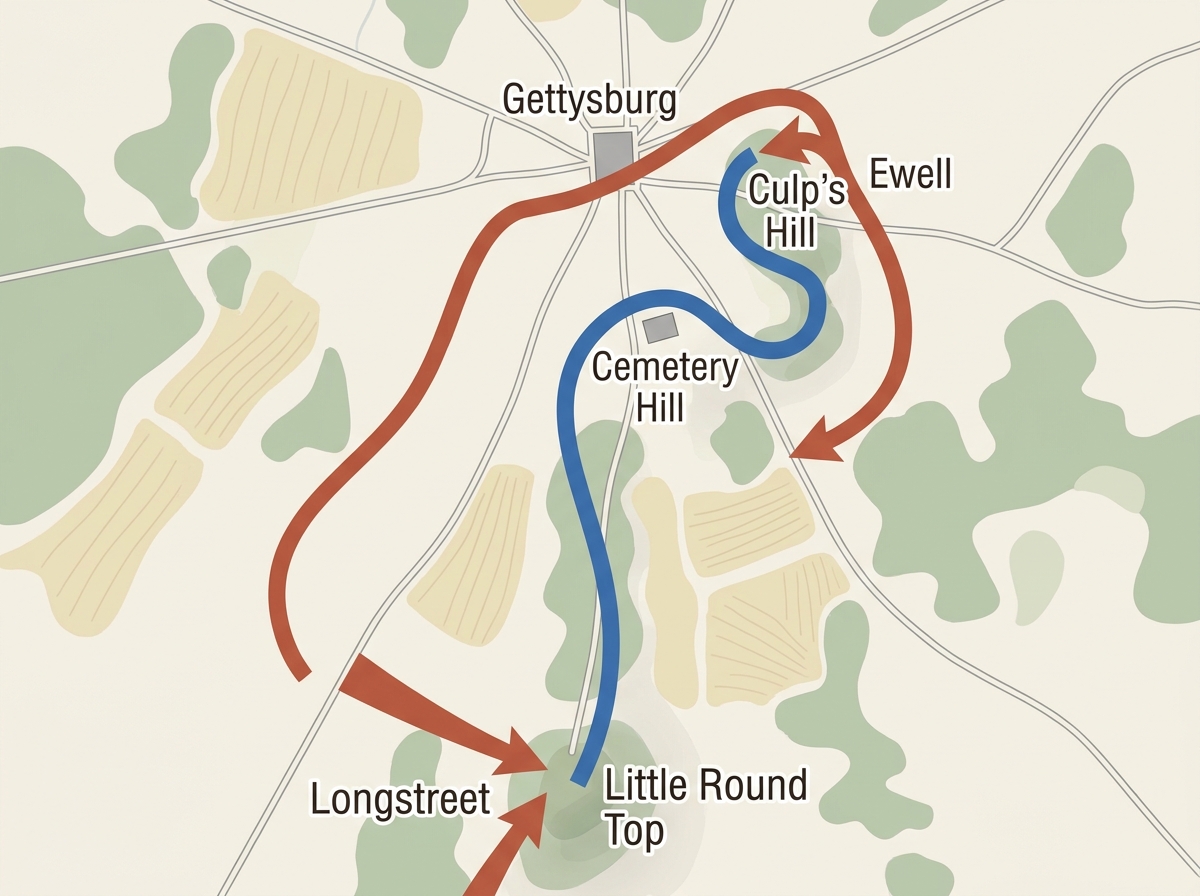
You could see it from the air, if anyone could have gotten up there. From a wooded knob called Culp’s Hill in the north, the Union line bent west over Cemetery Hill and then ran straight south down the spine of Cemetery Ridge for nearly two miles to a pair of rocky hills called the Round Tops. Drawn on a map it looked exactly like a fishhook — the barb hooking east at Culp’s Hill, the long shank running south down the ridge, and Little Round Top anchoring the very bottom of the curve.
A beaten army had stumbled backward onto the best ground on the field.
The shape was not just pretty. It was the whole game. A defender curled into a fishhook has what soldiers call interior lines — the inside of the curve is a short, straight chord, so a man (or a brigade, the few-thousand-man building block of a Civil War army) can be marched from the northern barb to the southern shank across the inside of the hook in a fraction of the time it takes an attacker to march the long way around the outside. Meade (North), the careful Pennsylvania engineer who had been handed command of this army only four days earlier, could shuttle troops to whatever part of his line was screaming loudest. Lee (South), attacking from the outside of the curve, would have to march miles to do the same thing. The Union had lost the first day and won the ground.
Lee’s certainty, Longstreet’s dread
Lee had three choices that morning, and he knew it: pull back and look for better ground, sit on the defensive and let Meade come to him, or attack. His most trusted subordinate, James Longstreet (South), wanted the second one — or really a version of the first. Longstreet had spent the night studying that fishhook and did not like the look of it. He wanted to slide the whole army south around the Union left, get between Meade and Washington, find some good defensive ground of their own, and make the Federals do the attacking. He had opposed this invasion from the start. Now he was looking at a fortified ridge two miles long and asking, in effect, why they should be the ones to climb it.
Lee said no. Lee was looking at the same ridge and seeing something different. He had the largest, most confident army he would ever command, deep inside the North, fresh off a year of beating bigger Union armies and a smashing win at Chancellorsville two months before. Hundreds of miles to the southwest, Vicksburg was about to fall to Grant (North), and a loud victory here might be the thing that changed the war’s whole arithmetic. Lee believed his men could do anything. He had reason to. That belief was about to cost him.
The plan he gave Longstreet was an oblique attack — not a head-on charge into the strongest part of the line, but a blow up against the Union left flank, the southern end of the shank, rolling the enemy line up from its open end like a rug. While Longstreet hit the left, Ewell (South) would press the right at Culp’s Hill, so Meade couldn’t strip troops from one end to save the other. The center would only feint.
On paper it was elegant: hit both ends, pin the middle, and let the fishhook tear itself apart trying to defend everywhere at once. On the ground it would unravel almost from the first step — and the first thing to go wrong was simply getting Longstreet into position.
Sickles takes a walk
It turned into an ordeal. Lee wanted Longstreet’s two divisions hidden, so they took a long, looping, concealed approach march, doubling back when the route threatened to expose them to a Union signal station, and waited besides for one of Longstreet’s brigades (Law’s) to come up from a hard march of its own. Noon passed. One o’clock, two o’clock, three. By the time Longstreet was finally ready, it was past four in the afternoon — and the line he was about to hit was no longer the line anyone had planned for.
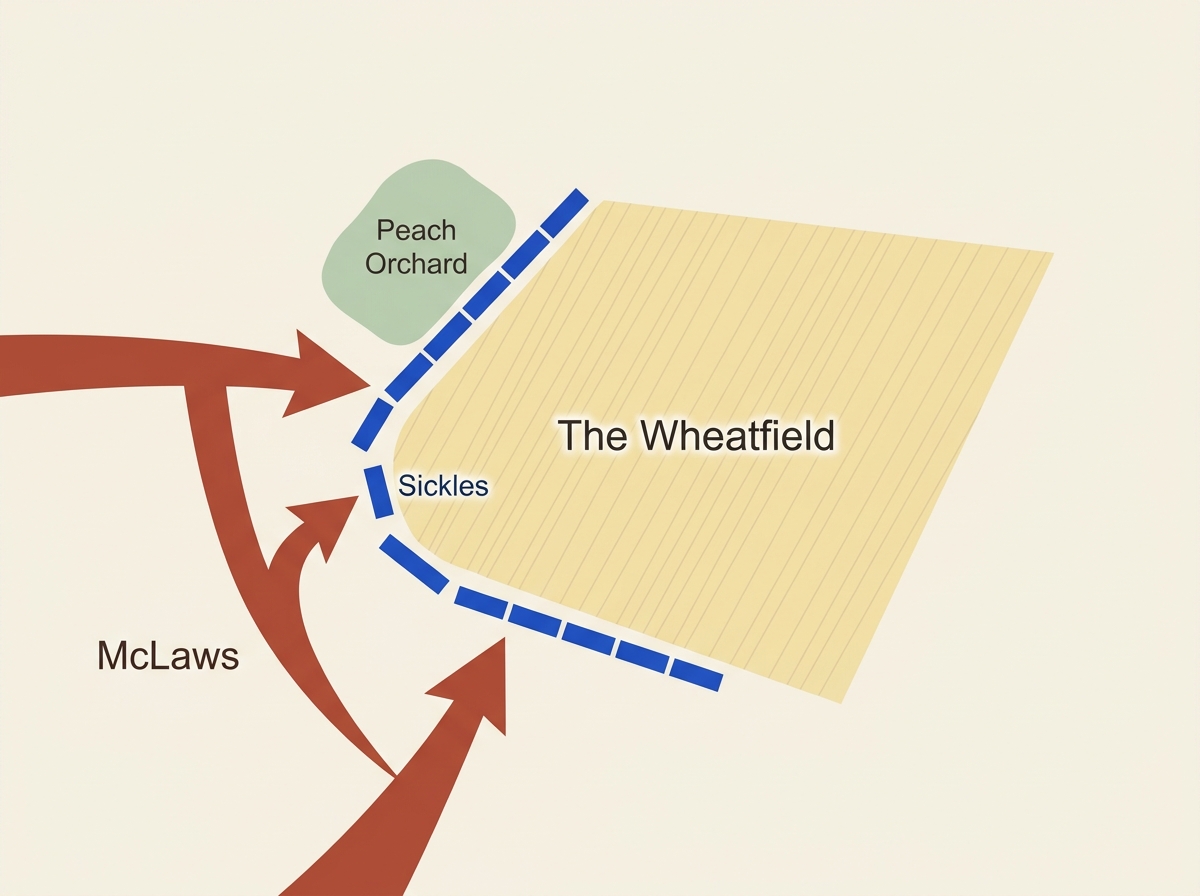
The trouble was a Union general named Daniel Sickles (North), a New York politician in a soldier’s coat, commanding the III Corps at the southern end of Meade’s line. Sickles did not like the low, soft ground he’d been assigned along the bottom of Cemetery Ridge. Out in front of him, three-quarters of a mile west, the ground rose a little to a peach orchard. He decided, entirely on his own authority, that the higher ground was better — and he marched his whole corps forward off the ridge and out into the open, bending his line around the Peach Orchard and back through a wheatfield, with both ends hanging in the air, anchored to nothing.
When Meade rode out and saw what Sickles had done, he was appalled. Sickles had pushed a salient — a bulge sticking out from the main line, exposed to fire on more than one side — far in front of the army, and there was no time left to pull it back before the Confederates came. Sickles, sensing the storm, offered to withdraw. Meade told him it was too late, and put the whole disaster in a single dry sentence:
this is neutral ground, our guns command it, as well as the enemy’s.
Then the Confederate artillery opened up, and the argument was over. Whether Sickles had committed a brilliant stroke or a court-martial offense would be argued for the rest of his long life — he died fifty-one years later, still arguing. What is certain is that his men were about to pay for the geometry.
Devil’s Den
Longstreet’s attack opened at the far southern end, around four-thirty, and it opened with John Bell Hood (South). Hood was one of the hardest-driving fighters in Lee’s army, and he did not like his orders — he’d asked repeatedly to swing wider around the Union flank and been refused every time. He attacked straight ahead. Almost at once, an artillery shell burst in the air above him and tore into his left arm, and Hood was carried off the field before his assault had really begun, his division surging on without the man who was supposed to steer it.
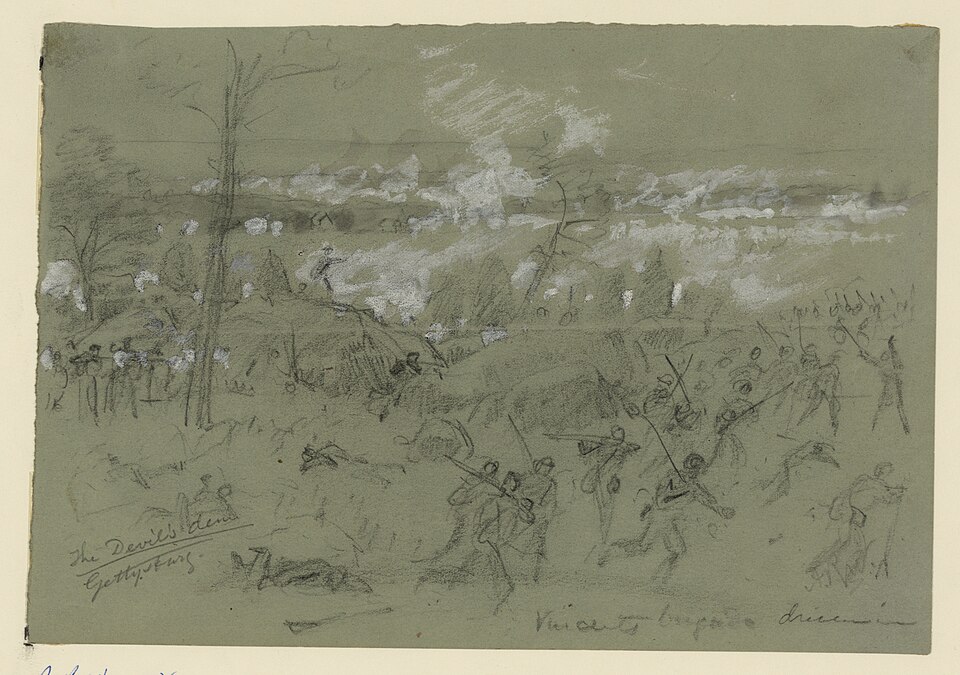
What it surged into first was the Devil’s Den — a jumble of car-sized granite boulders at the base of the slope, a place that looked like the world had been dropped and shattered. Holding it was a Union brigade under J.H. Hobart Ward (North), about 2,200 men in six regiments. The fighting there was close and ugly, men firing at each other across gaps in the rock at a few yards’ range, then clubbing and grabbing when there was no time to reload.
The hardest of it fell on the 124th New York. Their colonel, Augustus Van Horne Ellis, and their major, James Cromwell, both went down dead leading their men among the boulders. Ward’s brigade held the Den for the better part of an hour — and then the weight of Hood’s attack told, and they didn’t. Of the roughly 2,400 Union men engaged around Devil’s Den, 821 were killed, wounded, or captured. The Confederates lost more — somewhere near 1,800 of the 5,500 who came at the rocks. The granite kept the bodies the way a fist keeps a coin.
By the time the rocks belonged to the Confederates, several regiments of Alabamians and Texans were already jogging up the wooded slope just to the south. They couldn’t see the crest through the trees. They didn’t yet know there was anyone up there at all.
Little Round Top
The story everyone knows about Little Round Top is the bayonet charge. Joshua Lawrence Chamberlain (North) — a college professor from Maine, a man who taught rhetoric and modern languages and had talked his way into a uniform two years earlier — in command of the 20th Maine on the far left end of the entire Union army, his men shot down and out of ammunition, ordering them to fix bayonets and charge straight down the hill into the enemy. It is a true story. It happened. And the way it usually gets told, it sounds like the whole battle.
It is not the whole battle. It is about twenty minutes of it.
The genuinely decisive thing had happened a little earlier, and it was almost an accident. Gouverneur K. Warren (North), the chief engineer of the Army of the Potomac — a mapmaker, not a combat commander — rode up to the crest of Little Round Top to have a look at the ground and found, to his horror, that the most important hill on the southern end of the field was empty. Sickles had marched everyone forward into his salient and left the army’s anchor undefended. Then Warren looked west through the trees and saw sunlight glinting off the muskets of an entire Confederate line moving straight toward the hill he was standing on, alone. If those men took this crest, they could put guns on it and fire straight down the length of the whole Union line. The battle could be lost in the next half hour, on a hill nobody was holding.
Warren turned and started screaming for troops, grabbing whole brigades that happened to be marching past below and shoving them up the slope on his own authority. The race that followed was a matter of minutes.
Strong Vincent’s (North) brigade got there first, sprinting up the back of the hill and flinging itself into line just as Hood’s men came up the front; Vincent was shot down almost at once, mortally wounded. Behind him came Patrick “Paddy” O’Rorke (North), who led the 140th New York up the slope at a dead run and was killed in the first volley. The Union artilleryman who manhandled his guns onto that impossible rocky crest, Charles Hazlett, was killed there too. Men were dying to hold a hill they had reached only seconds before the enemy.
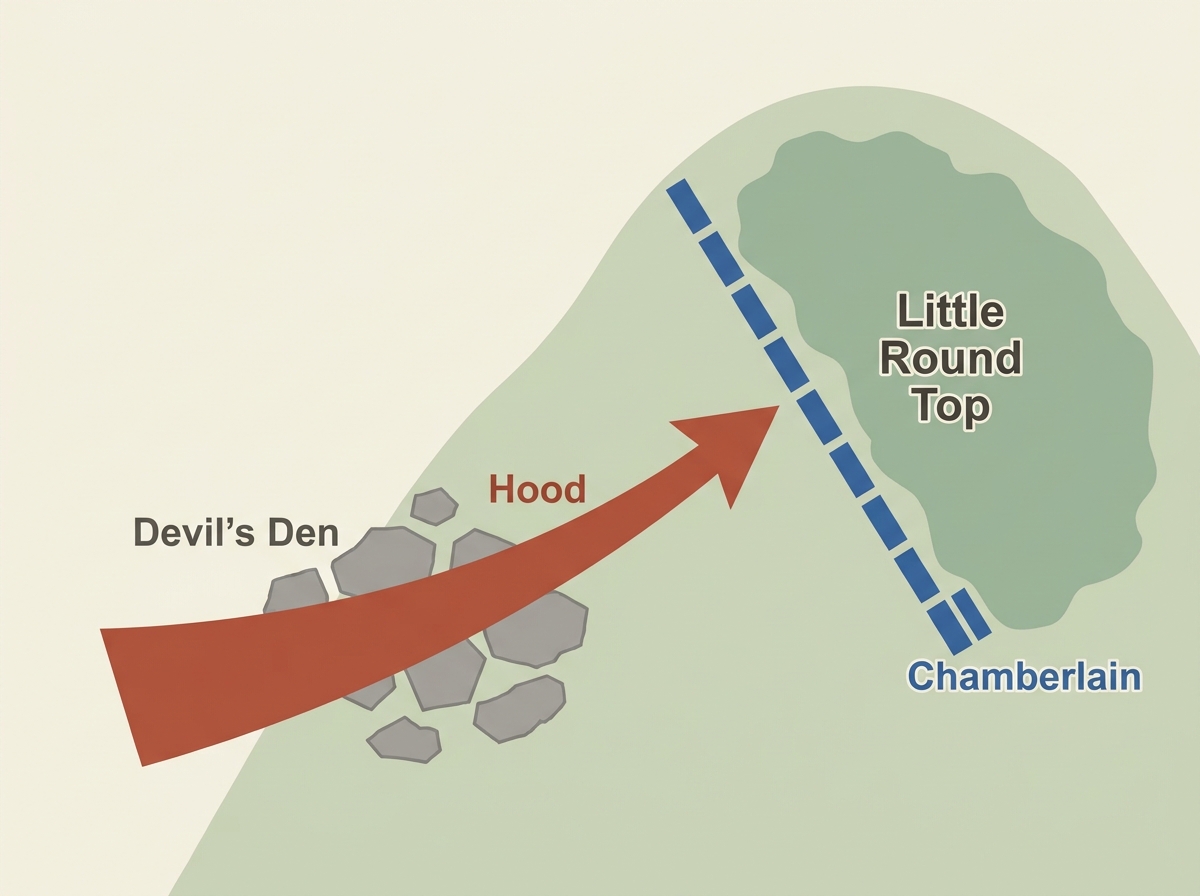
And on the very end of that scrambled line, anchoring the left of the left of the left — the last man on the flank of the entire Army of the Potomac — was Chamberlain and his 20th Maine. In front of him, climbing the slope again and again, was William C. Oates (South) and the 15th Alabama, men who had already marched far that day in the heat and were now being asked to take a hill by storm. They came up the rocks and were thrown back, re-formed and came again, and again, working around toward Chamberlain’s open flank, until the Maine men were folding their line back on itself like a closing gate and were nearly out of cartridges.
That is the moment of the famous charge — and stripped of the legend, it is somehow more impressive, not less. Chamberlain had no ammunition and no orders that fit the situation, so he invented one: fix bayonets and go downhill, swinging the line like a door to sweep the slope clean. It worked. The 15th Alabama, exhausted and surprised, broke and ran. Chamberlain would win the Medal of Honor for it, and he earned it. But the hill had been saved twenty minutes before he charged, by an engineer who happened to ride up at the right moment and have the nerve to scream. Keep both halves of the story. The legend is the bayonet charge. The lesson is Warren.
The Wheatfield
While Little Round Top was being saved, the ground just to the north turned into a place that does not have a clean name in the language because nobody has ever wanted to describe it twice. It was a wheatfield — about nineteen acres of waist-high grain on a small farm between the Peach Orchard and the rocks — and over the next few hours it became the closest thing the war produced to a vision of hell.
Somewhere around nineteen or twenty brigades from both armies were fed into those nineteen acres, piece by piece, over the course of the late afternoon and evening. The Wheatfield was taken and lost and taken again so many times that no one could keep an honest count; the figure people remember is six. Lines came across the standing wheat, were shot down in it, were replaced, charged, were driven back across their own dead. Roughly twenty thousand men fought there. Around a third of them became casualties. Two Union colonels, Edward Cross and Samuel Zook, were both mortally wounded leading brigades into it.
This is the thing people are pointing at when they call the Civil War the first modern war. Not the maps or the railroads. This — a flat field of trampled grain where industrial firepower met masses of men standing upright in the open, and ground them up by the thousand for a patch of farmland that, by sundown, belonged to nobody at all.
The Peach Orchard
At the front point of Sickles’s salient, around six o’clock, the bill came due. The Confederate attack rolled up against the Peach Orchard from more than one direction, and the man who broke it was William Barksdale (South), a fire-breathing Mississippi congressman who had been straining at the leash all afternoon to be turned loose. When he finally got the order he led his brigade in personally, on horseback, white hair streaming, out in front of his men — and they cracked Sickles’s salient open like an egg. Barksdale was shot from his horse and killed in the charge he had begged for.
The salient collapsed. The III Corps, strung out in the open exactly as Meade had feared, came apart. And Sickles himself, the politician who had marched these men off the ridge, was hit by a cannonball that mangled his right leg; it was amputated that evening. By one well-worn account he was carried off the field sitting up and smoking a cigar, determined to be seen looking unbothered. For the rest of his long life he insisted that his unauthorized advance had actually won the battle — had broken up Longstreet’s attack before it reached the real line. Almost nobody who had been in the Wheatfield agreed with him.
Behind the wreckage of Sickles’s corps, the broken Union pieces fell back toward the ridge they should never have left — and the line, bending and buckling, held. Meade’s interior lines did exactly what the fishhook had promised: he pulled brigades from the quiet parts of his curve and rushed them to the screaming part, and plugged the holes faster than Longstreet could tear them.
Culp’s Hill
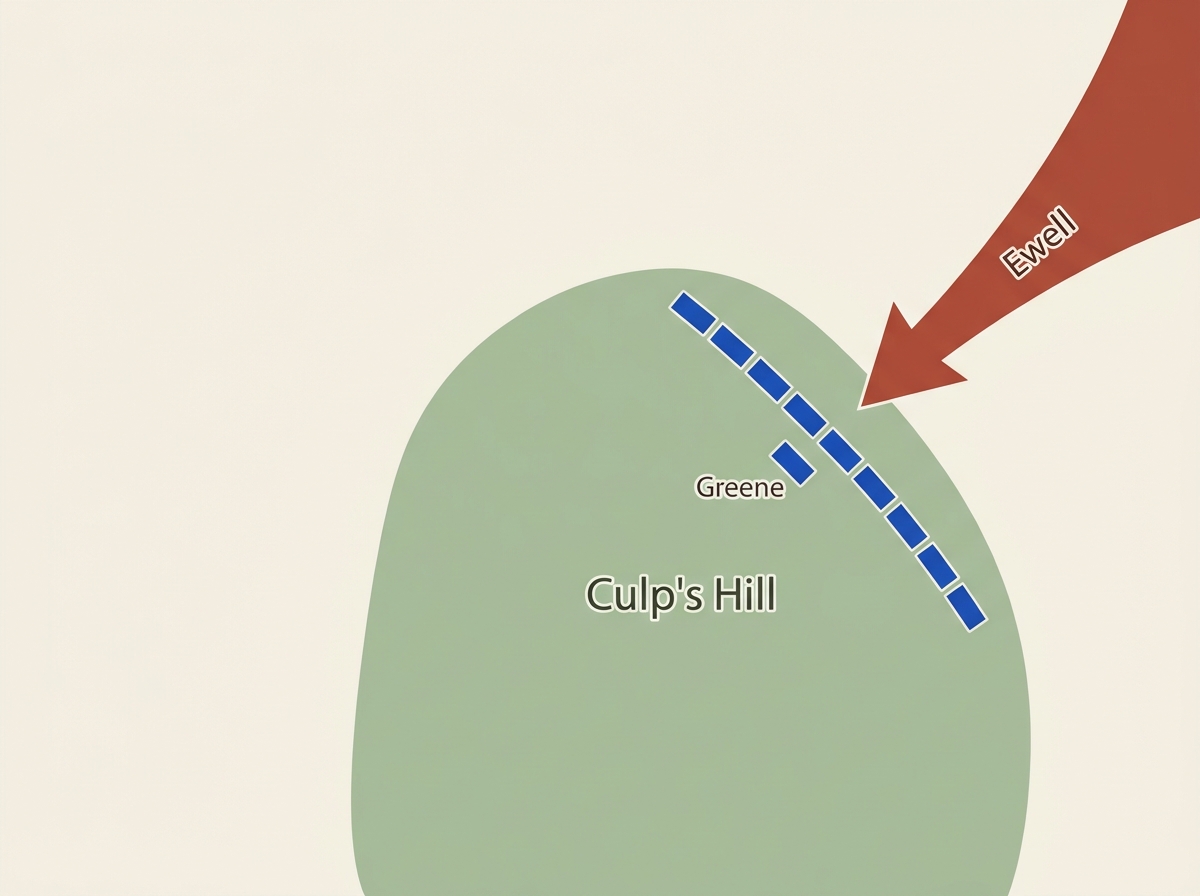
While the southern end of the field was being fought to a standstill, the northern barb of the fishhook finally caught fire. Ewell (South) had been ordered to attack Culp’s Hill in coordination with Longstreet. He didn’t get going until evening, nearly sundown, by which point most of the day’s damage was done. When his blow finally landed, it landed soft — because the Union had handed almost the entire defense of that hill to a single brigade and a single stubborn old man.
The hill was held by the brigade of George S. Greene (North), and only Greene’s brigade — the rest of the corps that should have been there had been marched south to help in the crisis around the Wheatfield. It was Edward “Allegheny” Johnson’s Confederate division (South) — one division, and even that one short a brigade — that came at Greene in the dusk. (The popular telling that three Confederate divisions stormed Culp’s Hill is simply wrong; it was Johnson’s one.) Even so, one division against one brigade is desperate arithmetic, and the only reason it didn’t end in a rout was Greene himself.
Greene was sixty-two years old, a West Point graduate of the class of 1823 — forty years gone — who had left the army for a distinguished career as a civil engineer (he helped lay out New York City’s water system) before the war called him back. He had spent the afternoon making his men dig, hauling logs and earth into a line of breastworks (chest-high field fortifications of dirt and timber thrown up to stop bullets) along the crest of the hill, over their tired grumbling. Those breastworks were the entire reason a single brigade could hold off a division. Greene’s men fired from behind cover at Johnson’s men climbing in the open, and held, and held, and held — until reinforcements finally came up through the dark and the hill was saved. An engineer’s caution, again, where it counted.
The line held
By midnight the firing had finally guttered out across the whole fishhook. It had been the largest, bloodiest day of the largest, bloodiest battle of the war — the rough estimates run to something like ten thousand Union casualties and just under seven thousand Confederate in that single afternoon and evening, killed, wounded, and captured. Hood was carried off with a ruined arm. Sickles was carried off with no leg. Barksdale and Vincent and O’Rorke and Cross and Zook and the colonel and major of the 124th New York were dead, and the Wheatfield was a carpet of men who would never be told apart again.
And the Union line was exactly where it had been at dawn. Bent in the middle where Sickles had bulged it forward and lost it, but unbroken end to end — Little Round Top held, the ridge held, Culp’s Hill held. Lee had thrown his army at both flanks of the fishhook, the left and the right, and both had bent and neither had snapped.
Robert E. Lee did not take that as a verdict. He took it as a near miss. He had hit the enemy’s left and the enemy’s right, and both times come within an arm’s length of breaking through. The one place he had not yet struck in force was the middle. So in the small hours of July 3rd, looking at the long quiet center of Cemetery Ridge, Lee made the decision that would define the rest of his life and the rest of the war.
He would attack the center.