The third morning
By the morning of July 3rd, Robert E. Lee (South) had thrown his army at both ends of the Union line and broken neither. Two days of the hardest fighting his army had ever done, and the enemy was still sitting on the ridge.
So Lee looked at the one place he had not yet hit: the middle.
The logic, if you can call it that, ran like this. He had struck the Union left and the Union right, which meant Meade (North) had surely pulled men from his center to shore up the wings. The center, then, was the thin spot. One massive blow straight up the middle, behind the heaviest cannon barrage the continent had ever heard, and the line would crack, and a cracked line is a beaten army. It was the kind of plan that looks clean on a map and costs you a generation of young men on the ground.
James Longstreet (South), the senior corps commander who would have to run the attack, thought it was madness, and said so. Longstreet had opposed the whole invasion. He had opposed the attack on the second day. Now, on the third morning, he made his case one more time: don’t do this. Slide the army around Meade’s left, get between the Union army and Washington, and let Meade be the one to attack uphill across open ground. Make the other man pay the butcher’s bill for once.
Lee would not hear it. To pull back now, after coming this far north, after two days of hurling men at the heights, was to admit the whole campaign had been a mistake — and Lee did not believe it had been. He had beaten this army before. He believed he could beat it here. There is a kind of confidence in a commander that wins battles for years and then, on one July afternoon, walks twelve thousand men into open ground because it cannot imagine losing. By the traditional account Longstreet was so sick at heart he could barely give the order when the moment came.
The force was about twelve thousand five hundred men, drawn from three divisions under Longstreet’s command — the divisions of George Pickett (South), James Pettigrew (South), and Isaac Trimble (South). Pickett’s was the freshest; his men had not yet been bloodied at Gettysburg, and Pickett himself, a flamboyant figure with perfumed ringlets in his hair, was hungry for the glory the first two days had handed to other men. Eagerness on one side of the field, dread on the other. Longstreet saw a slaughter coming. Pickett saw his chance.
Here is the first thing the famous name gets wrong: this was not Pickett’s charge. History calls it that, and history is being lazy. Pickett commanded just three of the eleven brigades that stepped off — the all-Virginia ones. The rest of the line belonged to Pettigrew (whose men were North Carolinians, Mississippians, Tennesseans, Alabamians, and Virginians) and to Trimble. When the killing was tallied, Pettigrew’s command lost about as many men as Pickett’s — roughly twenty-seven hundred each. Two-thirds of the brigades in that doomed advance were not Pickett’s at all, and most of the men who died doing it never served under him. The Virginia-centric name, settled on afterward, quietly erased the Carolinians and Tennesseans and the rest, who walked into the same guns and fell in the same numbers. Some historians, trying to give the dead their names back, call it the Pickett–Pettigrew–Trimble Assault. It does not have the same ring, which is exactly the problem. The version that’s easy to say is the version that forgot most of the men.
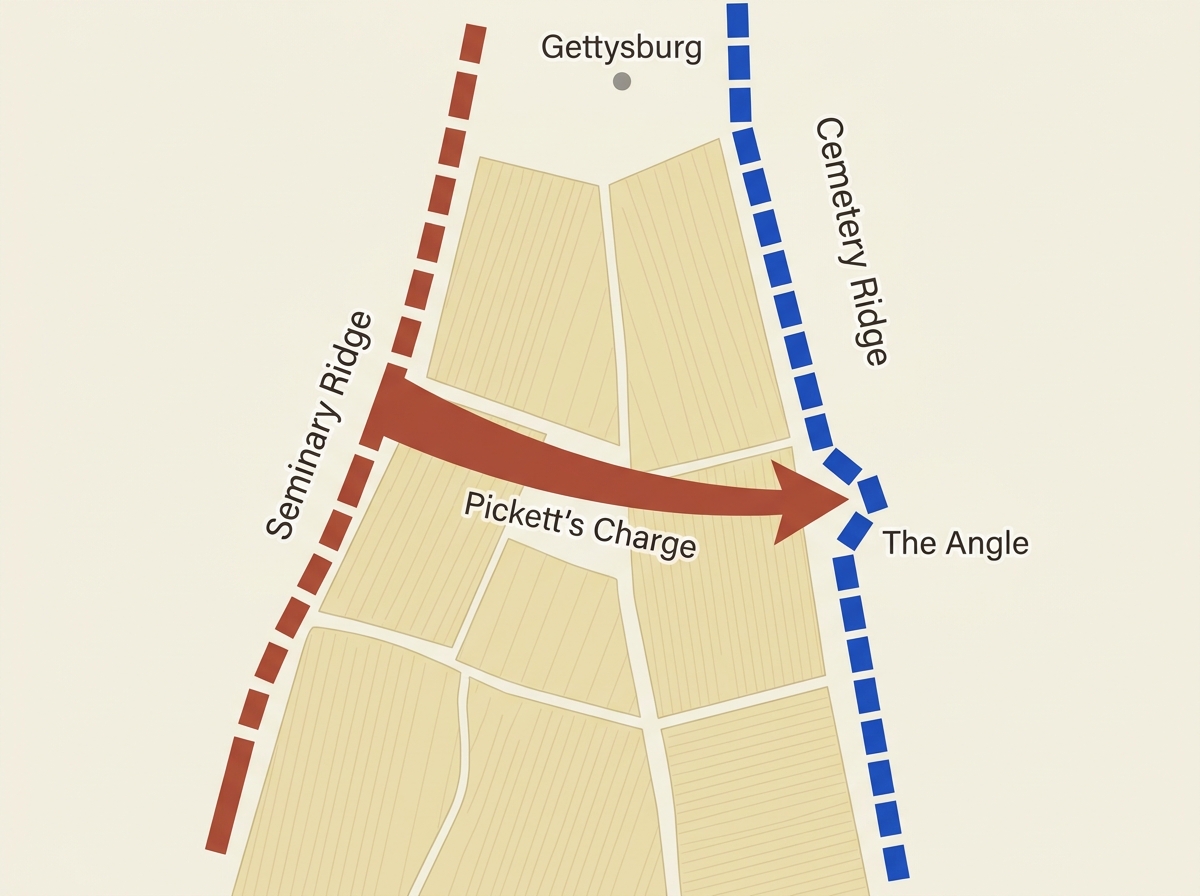
Their target was a small clump of trees on Cemetery Ridge, with a low stone wall in front of it that jogged at a right angle — a spot the soldiers called the Angle (a kink in the stone fence where the Union line stepped forward, then back). To get there, the men would have to cross roughly three-quarters of a mile of open ground, in the open, in the sun, in full view of every Union gun on the ridge. There was a fence line partway across — the Emmitsburg Road — that would funnel and slow them right under the muzzles. Modern historians still argue over whether Lee meant to aim a little north of the trees, but the copse and the Angle are where the story drove, and where the men died.
The cannonade
At about one in the afternoon, the largest artillery bombardment ever conducted on the North American continent began.
A cannonade is exactly what it sounds like — a sustained, hammering barrage of cannon fire, gun after gun after gun, meant to wreck the enemy’s defenses before the infantry goes in. Lee’s gunners opened with somewhere between one hundred fifty and one hundred seventy guns, ranged along Seminary Ridge and aimed at the Union center. The Federals answered with around eighty. For one to two hours the two ridges thundered at each other across the valley, a sound so enormous that people heard it rolling across the countryside for miles in every direction.
And most of it did nothing.
The smoke rolled up so thick the Confederate gunners could not see whether their shells were landing on the ridge or sailing over it. They were sailing over it. Round after round screamed past the Union infantry lying flat behind the wall and exploded in the rear — in the supply trains, among the horses, among the staff officers, terrifying and lethal but doing very little to the men who actually had to be killed for the charge to work. Then the Union guns went quiet. Some of that was to save ammunition for what everyone knew was coming. Some of it was a bluff, letting the Confederate gunners believe they had silenced the enemy batteries. Lee’s artillery chief, watching the Union fire slacken, took it for the green light. He sent word to Longstreet that now was the time, before the guns ran dry.
Longstreet could not bring himself to speak the order. By the traditional account he only nodded.
The charge
They came out of the tree line on Seminary Ridge a little before three o’clock, and for a moment it was the most beautiful and terrible thing anyone on that field had ever seen.
Twelve thousand men, dressing their ranks as if on a parade ground, three long lines stepping off together across a front nearly a mile wide, battle flags up, bayonets catching the afternoon sun. The Union soldiers waiting behind the wall — men who had spent two days being hit — looked out across that valley and saw the entire Confederate army, it seemed, walking straight at them in the open. Some of them said later it was the grandest sight of their lives. Then they remembered what they were going to have to do to it.
The men in gray walked. That is the part that breaks you, reading it now: they walked. A man at quick step covers a mile in something like fifteen, twenty minutes, and for the better part of that time the soldiers in the charge had nothing to do but keep walking forward, in step, into the muzzles, while the world came apart around them.
Try to stand in their line for a moment, because this is the day’s true center, and it has too often been told only from behind the wall. You are a Confederate soldier — a Virginian, or a North Carolinian, or a Tennessean — and you have just come out of the trees into the open with three-quarters of a mile of bare Pennsylvania farmland in front of you and not one thing to hide behind on any of it. Ahead, up on the ridge, are the guns. You can see them. You have been told to walk to them. You cannot run, because the line must hold its dressing or it shatters; you cannot fire, because there is nothing yet in range to fire at; you cannot do anything but put one foot in front of the other and keep your place in the rank while the man beside you is taken apart. The Union artillery opens while you are still far off — solid shot and exploding shell tearing lanes straight through the ranks, whole files of men simply gone, and the order comes down the line to close up, close up, which means step over what is left of your friends and fill the hole and keep walking. You do it. Most of you do it. Roughly half the men who started this walk will not finish it, and every one of them can do the arithmetic as they go.
Then you reach the Emmitsburg Road, a fence line partway across, and the lines bunch and tangle climbing it, slowing right under the muzzles at the worst possible moment — and here the gunners switch to canister, tin cans packed with iron balls that turn a cannon into an enormous shotgun, murderous at close range, and the Union infantry rises up behind the stone wall and adds the rifles. Solid shot far out, canister close in, rifle fire at the last. Some men get to that road and stop — they take what cover the fences give and they go no farther, and you cannot honestly call it cowardice when the alternative is the open lane in front of the Angle, which has by now become a place men simply do not survive crossing. The terrible thing is that the slaughter that did happen happened to the men who did not stop, who climbed the fence and kept going into it.
And some of them crossed it anyway.
A few hundred Confederates, mostly from Pickett’s division, reached the wall at the Angle — the only ones, out of twelve thousand, to touch the thing they had been sent to take. At their head was Lewis Armistead (South), a brigade commander who put his hat on the tip of his sword and held it high so his men could see him through the smoke, and led them up over the stone wall and in among the Union guns. For a few minutes there was hand-to-hand fighting at the breach — men clubbing each other with rifles, gunners defending their cannon. And then it was over. Armistead fell, mortally wounded, among the guns; he would die in a Union field hospital two days later. The handful who had crossed the wall were killed or captured where they stood. The rest of the charge — the men who were still alive in the field behind them — turned around and began the long walk back across the same three-quarters of a mile they had just crossed, with the Union guns firing into their backs the whole way.
That spot at the Angle, the farthest point the attack reached, is remembered as the “high-water mark of the Confederacy” — the high tide of the Southern cause, the closest the Confederacy ever came, on its best army’s best day, to forcing the issue on Northern soil. It came up to a stone wall, and a few hundred men got over it, and then it went out, and it never came that far again.
The cost was past anything that word can hold. Of the roughly twelve thousand five hundred who stepped off, more than half did not come back — somewhere around six and a half thousand men killed, wounded, or captured in well under an hour. Pickett’s division alone lost more than two thousand six hundred; Pettigrew’s command lost about as many again. The boys who walked out so beautifully at three o’clock came back, those who came back at all, in ones and twos, bleeding, some carrying wounded friends, all of them under fire.
“I have no division”
What Lee did next is one of the most-told scenes in American history, and it is also, by the honest reckoning of modern historians, one of the most uncertain. Scholars including Earl Hess, Stephen Sears, and Jeffry Wert have questioned whether the meeting between Lee and Pickett happened as the legend tells it. So take what follows as the story the survivors and their descendants kept, and held onto, and may have improved in the keeping — because true or not, it is the thing the South chose to remember about that afternoon.
By the traditional account, Lee rode out alone to meet the survivors as they staggered back across the field, and what he said was not a general’s excuse but a confession. He is remembered to have told them:
This has all been my fault.
He is said to have gone among the broken men telling them to re-form, that the fault was his and the failure was his, that they must hold together for what was left. And when he found Pickett and asked him to ready his division to repel a counterattack, Pickett — whose division had effectively ceased to exist in front of the stone wall — is said to have replied:
General Lee, I have no division.
Whether those exact words were ever spoken, no one can now prove. What is not in doubt is the thing the words point at: a division had walked into that valley, and a division did not walk out, and the man who ordered them in knew it. The attack was broken. The invasion of the North was broken with it. That night, and the next day, the Army of Northern Virginia would begin the long road home.
Lee had come north to win the war in an afternoon. He had instead given it its turning point — for the other side.