The morning of July 4th
It rained.
It rained on the Fourth of July, 1863, and it rained on the dead, who were still where they had fallen — in the wheat, in the orchard, in the woods, along the stone walls, by some counts seven thousand of them between the two armies, with the wounded and the dead horses uncounted on top of that. Three days of fighting around a small Pennsylvania market town had produced something close to fifty thousand casualties — killed, wounded, or captured — split roughly evenly between the two sides, an estimated twenty-three thousand for the Union under George Meade (North) and somewhere between twenty-three and twenty-eight thousand for Robert E. Lee’s (South) army. It was, and remains, the costliest battle ever fought in North America. And now it was over, and it was raining, and somebody had to move.
Lee moved first, south. His wagon train of wounded stretched for some fifteen miles — ambulances and supply wagons groaning down the muddy roads toward the Potomac and Virginia, escorted by Confederate cavalry under Gen. John Imboden (South), the men inside it crying out at every jolt of the wheels in the ruts. It was a retreat, and everyone in both armies knew it was a retreat, and the only question left was whether Meade would turn it into a rout.
He did not. Meade let Lee go. He had a battered army of his own, he had just survived three days that could have lost the war, and he chose to follow rather than fall on the retreating column and try to destroy it. Whether that was prudence or timidity — whether a harder man would have ended the Army of Northern Virginia right there on the swollen banks of the Potomac — became an argument that followed Meade for the rest of his life, all the way to Washington, where an impatient president and an impatient Congress wanted to know why the beaten enemy had been allowed to walk home. It was, almost word for word, the same question that had been asked of McClellan after Antietam the year before. The North kept winning the great defensive battle and then standing still while the chance to finish it walked away.
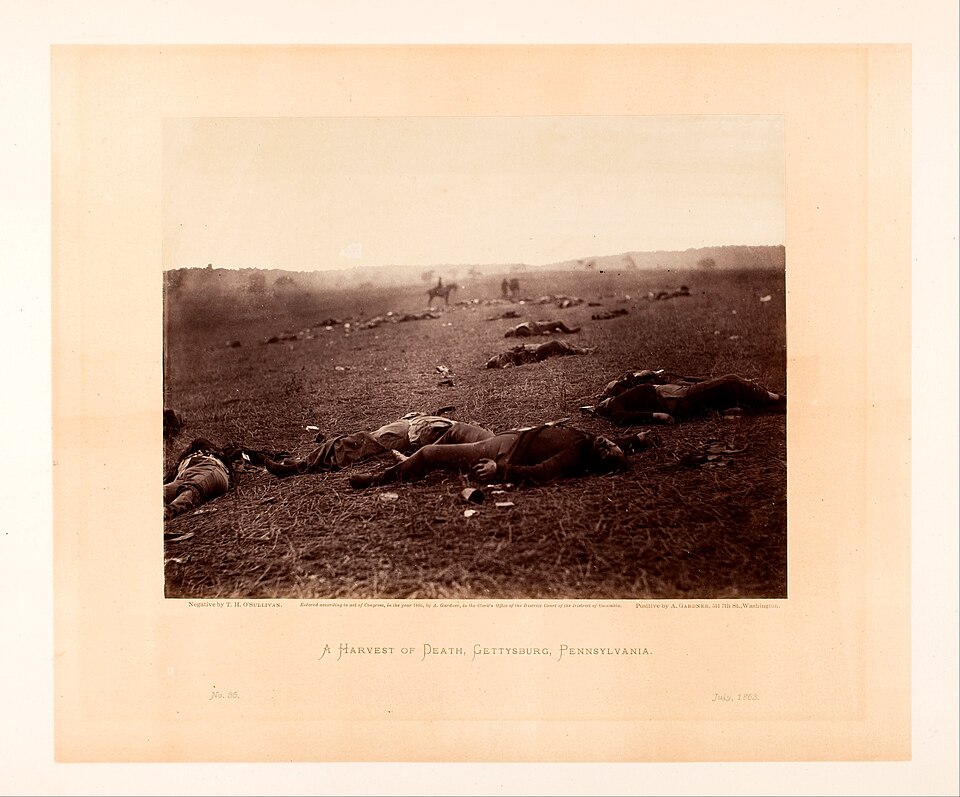
There is a photograph from those days — one of the most famous photographs of the entire war. Timothy O’Sullivan, working the battlefield in the rain-soaked aftermath, made an image of the Union dead lying scattered across the open ground, faces to the sky, and it was titled “A Harvest of Death.” That is what the field was. The grand parade-ground lines of the day before had become a harvest, and the photographers walked it before the burial parties did, and for the second time in the war (the first was Antietam) the people at home were made to look at exactly what their newspapers’ casualty columns actually meant.
Two surrenders, one day
And here is the coincidence that turned a battle into a turning point.
On that same Fourth of July, eight hundred miles to the southwest, the Confederate fortress city of Vicksburg surrendered to Ulysses S. Grant (North). Vicksburg was the last great Confederate stronghold on the Mississippi River, and with its fall the entire river — from its headwaters down to the Gulf — passed into Union hands. The Confederacy was now cut in two: Texas, Arkansas, and most of Louisiana sliced clean off from the rest of the South, the great water highway that had carried the Southern economy now belonging to the enemy.
So on a single day — July 4th, 1863 — Lee’s invasion of the North broke and turned for home, and the Mississippi River fell, and the Confederacy was split down the middle. Historians ever since have marked this as the hinge of the war, the week the Confederacy stopped being a nation that might win and started being a nation that was running out of time. And here is the line that earns the word turning point: Lee’s army never invaded the North again. The Army of Northern Virginia turned south after Gettysburg and fought the entire rest of the war on the defensive, on its own ground, reacting to its enemy instead of dictating to him. The South would fight on, hard, for nearly two more years. But after that Fourth of July, it was fighting the clock.
Two minutes at the cemetery
The meaning of it all, though — the words that turned fifty thousand casualties into something a country could carry forward — came four and a half months later, and they took about two minutes to say.
That summer and fall, the town of Gettysburg had been digging. The dead could not be left in the fields where O’Sullivan had photographed them, and so a proper burial ground for the Union soldiers, the Soldiers’ National Cemetery, was created on the very ridge they had died defending. On November 19th, 1863, it was dedicated, and Abraham Lincoln (North) was invited to attend and offer, as the program put it, “a few appropriate remarks.”
He was not the main event. The featured orator was Edward Everett, the most celebrated public speaker in the country, a former senator and secretary of state and president of Harvard, and Everett did what featured orators did: he spoke for about two hours, some thirteen thousand words, a full classical oration on the battle and the war and the cause. Then Lincoln stood up and spoke for about two minutes.
He said about two hundred seventy words — ten sentences. It is, line for line, very likely the most important short speech in the English language, and it began:
Four score and seven years ago our fathers brought forth on this continent, a new nation, conceived in Liberty, and dedicated to the proposition that all men are created equal.
Look at the arithmetic in the first sentence. “Four score and seven” is eighty-seven years. Lincoln was speaking in 1863, and eighty-seven years back puts you at 1776 — not the Constitution of 1787, but the Declaration of Independence. That was the quiet, enormous move. The Constitution had made its peace with slavery; the Declaration was the older document, the one that said all men are created equal. Lincoln reached past the compromise and named the promise as the nation’s true beginning — and told a country in the middle of killing itself that the war was about finally making that promise real: that “this nation, under God, shall have a new birth of freedom,” and that “government of the people, by the people, for the people, shall not perish from the earth.”
Twelve thousand men had walked into the open at the Angle. Fifty thousand had fallen across three days. And four months later, in two minutes, the president told the country what all of it had been for.