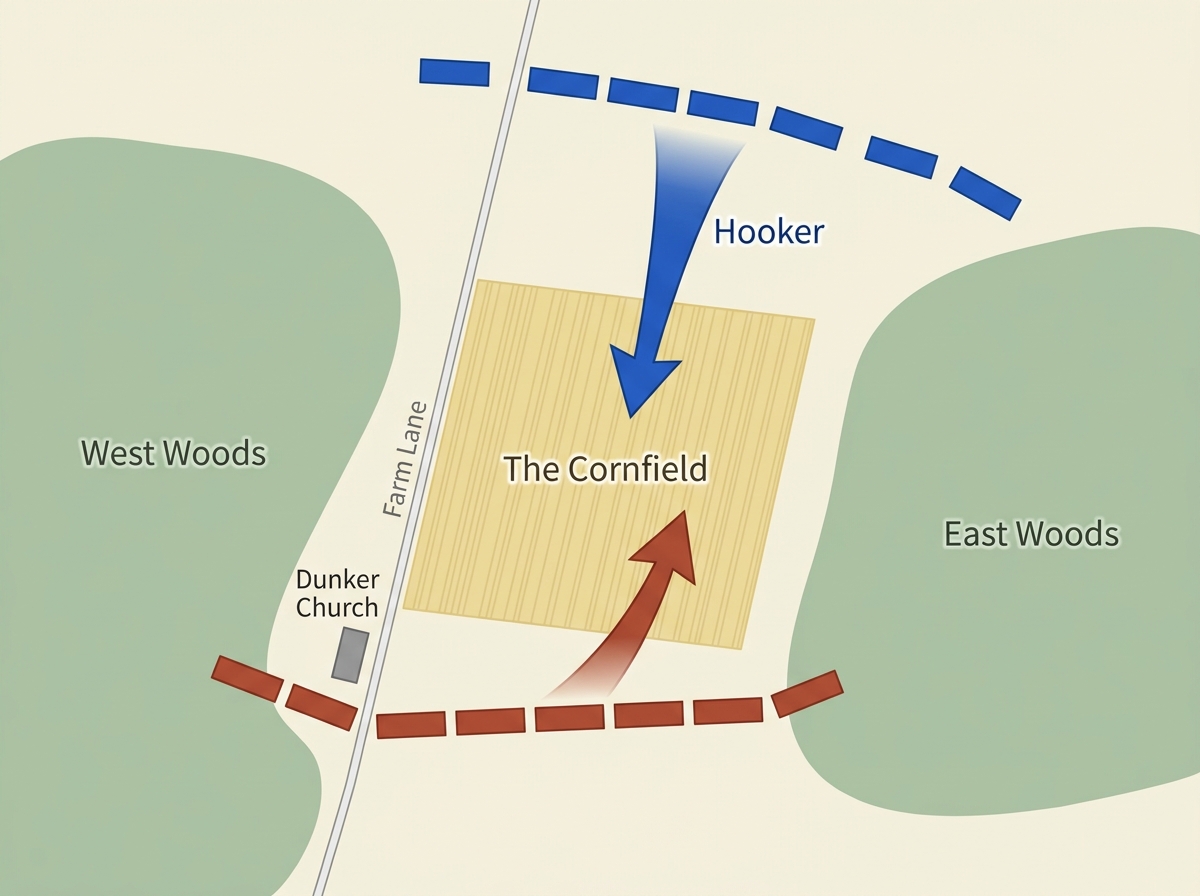
The day did not happen all at once. Antietam was really three battles fought one after another, rolling from the north end of the line to the south across a single September day, as if neither army could manage to fight everywhere at the same time. The first one started at dawn, on the northern end, in a farmer’s cornfield.
Union Maj. Gen. Joseph Hooker (North) sent his I Corps — a corps being the army’s biggest building block, on the order of ten to fifteen thousand men, itself made of smaller divisions, and those of smaller brigades — smashing into the left of Lee’s line — the wing held by Maj. Gen. Thomas “Stonewall” Jackson (South) — straight through a field of standing corn owned by a farmer named Miller. The corn was tall and ripe, taller than a man, and it hid soldiers until they were close enough to kill each other in the face. Lines surged forward, were shot to pieces, fell back, were replaced, and surged again. Miller’s Cornfield changed hands, by some counts, roughly fifteen times in a few hours. Hooker wrote in his official report that the corn had been cut “as closely as could have been done with a knife, and the slain lay in rows precisely as they had stood in their ranks a few moments before.” The corn was cut down. So were the men standing in it.
For a while it was the Confederate left simply absorbing the blow and bleeding. Then the South hit back. Brig. Gen. John Bell Hood’s (South) division had been pulled out of the line just before dawn to cook the first hot breakfast the men had seen in days — and they were yanked off their half-cooked food and thrown straight into the Cornfield, hungry and furious. Hood’s counterattack was the engine behind all that back-and-forth: his division came screaming north through the corn and drove the Union troops back out of it, shoving the morning’s tide the other way. It is a large part of why the field changed hands so many times instead of falling once and staying fallen. It also cost him nearly everything. Hood’s division was wrecked doing it, losing somewhere around sixty percent of its men in the corn. Asked afterward where his division had gotten to, Hood is supposed to have answered that it was dead on the field. Whether or not he said it in exactly those words, it was very nearly the literal truth.
The corn was eating Union generals as fast as it ate enlisted men. Around mid-morning Hooker himself was shot through the foot and had to be carried from the field, and with him went the one commander who had been driving the whole northern attack — leadership of his I Corps passing on the spot to Brig. Gen. George Meade (North). And the morning was not one corps but a relay of them: when Hooker’s drive stalled, a second wave came up behind it, Maj. Gen. Joseph K. F. Mansfield’s (North) XII Corps, feeding fresh men into the same killing ground. Mansfield, a white-bearded old soldier of long service, rode forward to position his troops and was almost immediately shot down; he died of the wound the next day. Two senior Union generals were down before noon — one carried off, one dying — and a third corps was still waiting its turn to be fed in.
The North kept sending men into the same field, one corps after another, and the field kept handing the men back broken.
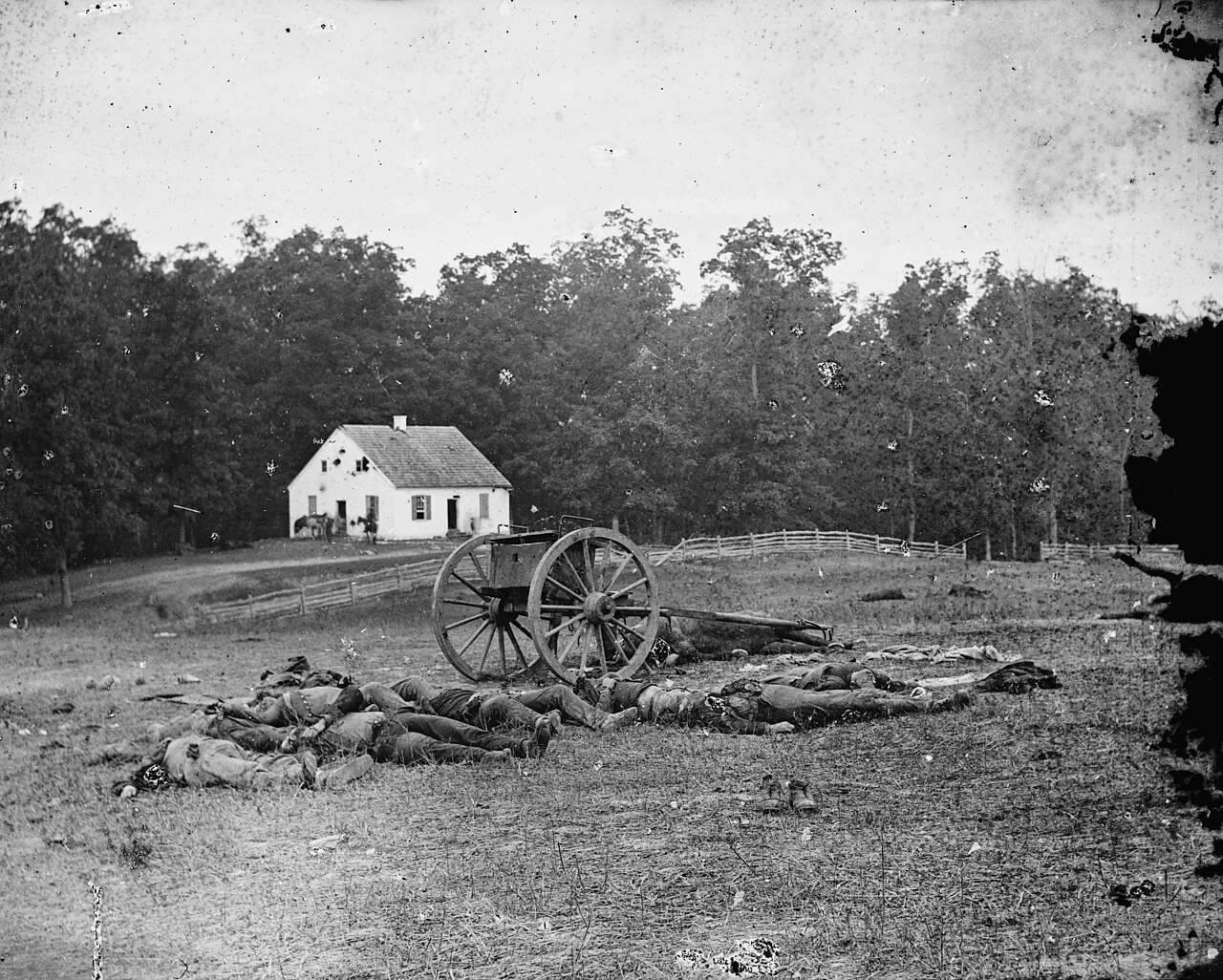
The Dunker Church
The fighting swirled around a small whitewashed building on the edge of the field: the Dunker Church. It belonged to the Dunkers, a German Baptist sect whose entire faith was built on plainness and pacifism — they believed Christians must never take up arms, never fight, never kill. Their modest little meetinghouse, raised by people who had renounced violence as a sin, became the bullet-scarred landmark of the worst single day of violence the country had ever seen. There is no way to make that irony gentle. The men of two armies bled out around the doorstep of a church whose congregation believed all of it was forbidden.
The West Woods
A little later, on that same northern end, the killing found a new low. A Union division under Maj. Gen. John Sedgwick (North) pushed into a stand of trees called the West Woods, marching in a tight formation right into a trap. Confederate troops were waiting on three sides. They opened fire into the packed Union ranks from the front and the flank (the exposed side of a formation) at once, and the division came apart. In roughly twenty minutes, Sedgwick’s men took around 2,200 casualties. Not in a day. In about the length of a coffee break. A man getting out alive ran back through his own dead and dying — friends he had marched in with that morning sprawled across the leaves, the wounded grabbing at his legs as he passed — and the woods behind him so thick with bodies you could not cross them without stepping on someone. The northern third of the battlefield had become a place where a man could be alive and whole one moment and one of thousands of bodies the next, and the sun was barely up.