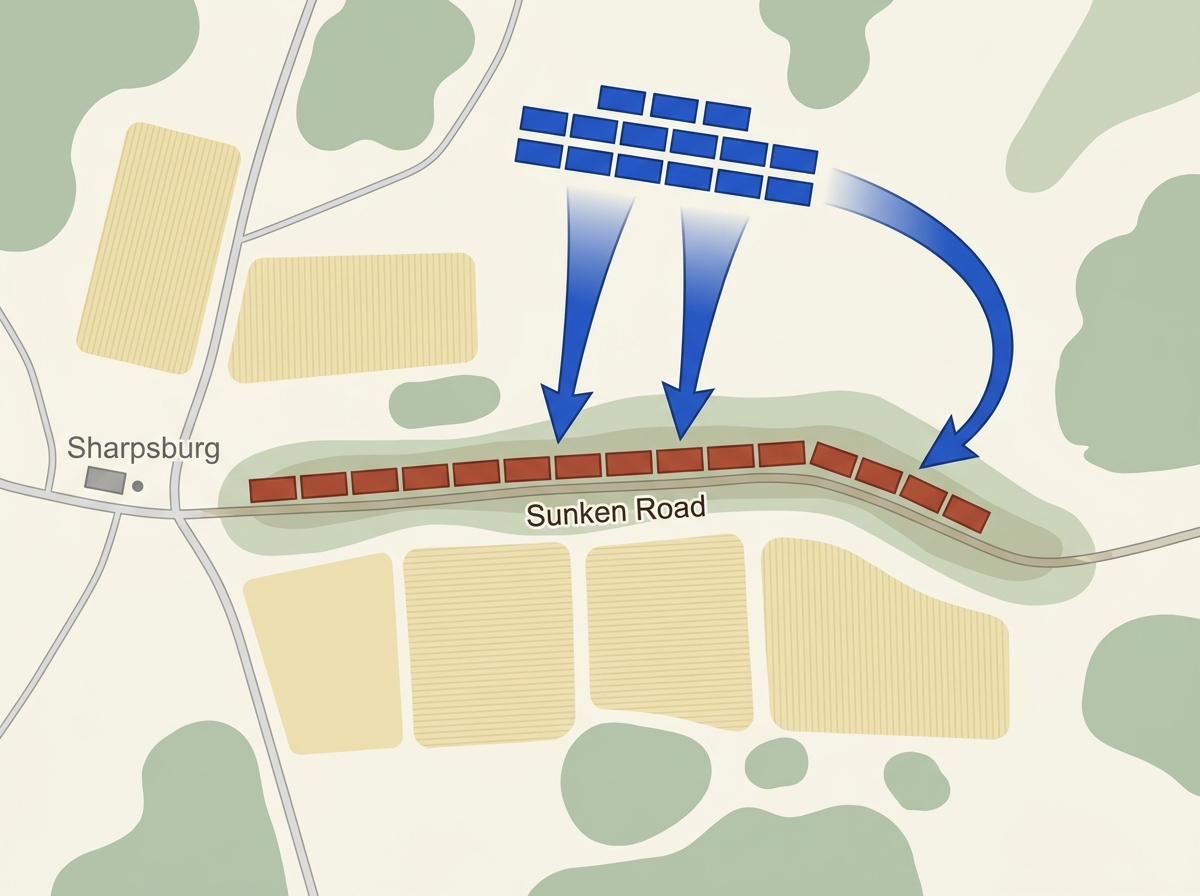
By late morning the fighting slid south to the center of Lee’s line — the wing commanded by Maj. Gen. James Longstreet (South) — where Confederate soldiers had taken cover in a worn-down farm lane. Years of wagon traffic had sunk the road below the level of the surrounding fields, turning an ordinary country path into a ready-made trench. Wave after wave of Union troops marched up the rising ground toward it and were shot down by the men sheltered in the sunken road. For hours the lane held.
One of those waves has a name. Among the Union brigades sent up the rising ground was the Irish Brigade — men recruited largely from Irish immigrant neighborhoods of New York and Boston, fighting under green regimental flags, led by Brig. Gen. Thomas Francis Meagher (North). Before they stepped off toward the lane, their chaplain, Father William Corby, rode the length of the line on horseback and gave the men general absolution — a Catholic priest’s blessing forgiving their sins all at once, the last rites of their faith granted in advance to soldiers about to walk into fire. Then they went forward. They walked into the worst of the sunken-road fire and were torn apart: the brigade lost on the order of five hundred and forty men in the attack, roughly three of every five who started up the slope. The green flags went down and were picked up and went down again. It is one of the most-told moments of the whole day — a brigade given absolution and then very nearly destroyed inside the next hour.
Then it didn’t. Union soldiers worked around to a position where they could fire straight down the length of the road, and the trench that had protected the Confederates turned into a killing chute with no cover. Men fell in heaps along its length. When it was over the lane had a new name that it still carries: Bloody Lane. The Federals had finally punched a hole clean through the center of Lee’s army.
The reserves that never moved
This was the moment. Lee’s center was broken open, his army split, his whole position one hard shove from collapse. McClellan (North) had an entire fresh corps in reserve — Maj. Gen. Fitz John Porter’s (North) V Corps — standing ready behind the lines, the men who could have driven through the gap and finished the Army of Northern Virginia for good. And McClellan, certain as always that Lee had hidden masses of men somewhere, refused to send them in. The hole closed. The chance passed. It was the great missed opportunity of the day, maybe of the war — the bigger army holding back the punch that could have ended its enemy.
Burnside’s Bridge
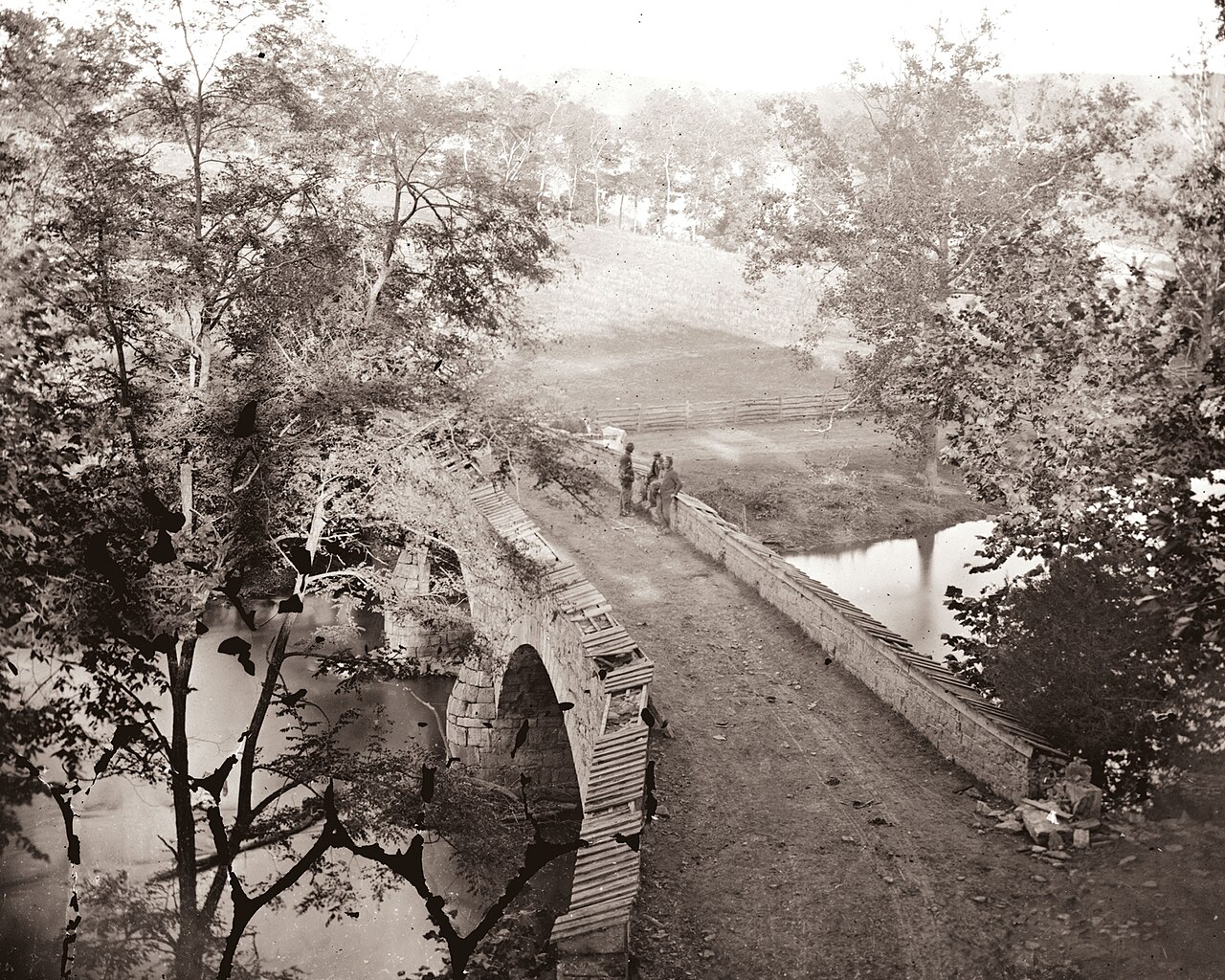
At the southern end of the field, a third battle had been grinding on. Maj. Gen. Ambrose Burnside (North) and his IX Corps spent much of the afternoon trying to cross a narrow stone bridge over Antietam Creek, defended by only a few hundred Georgia riflemen on the high bank above. The numbers tell the whole grim joke of it: thousands of men in blue, a few hundred in gray, hours of dying for a bridge they didn’t have to take. The Georgians, dug in on the heights, picked off anyone who set foot on the span — even though, as it turned out, the creek could be waded across at other spots not far away. Hours and lives went into forcing a bridge that didn’t have to be forced. It has been called Burnside’s Bridge ever since.
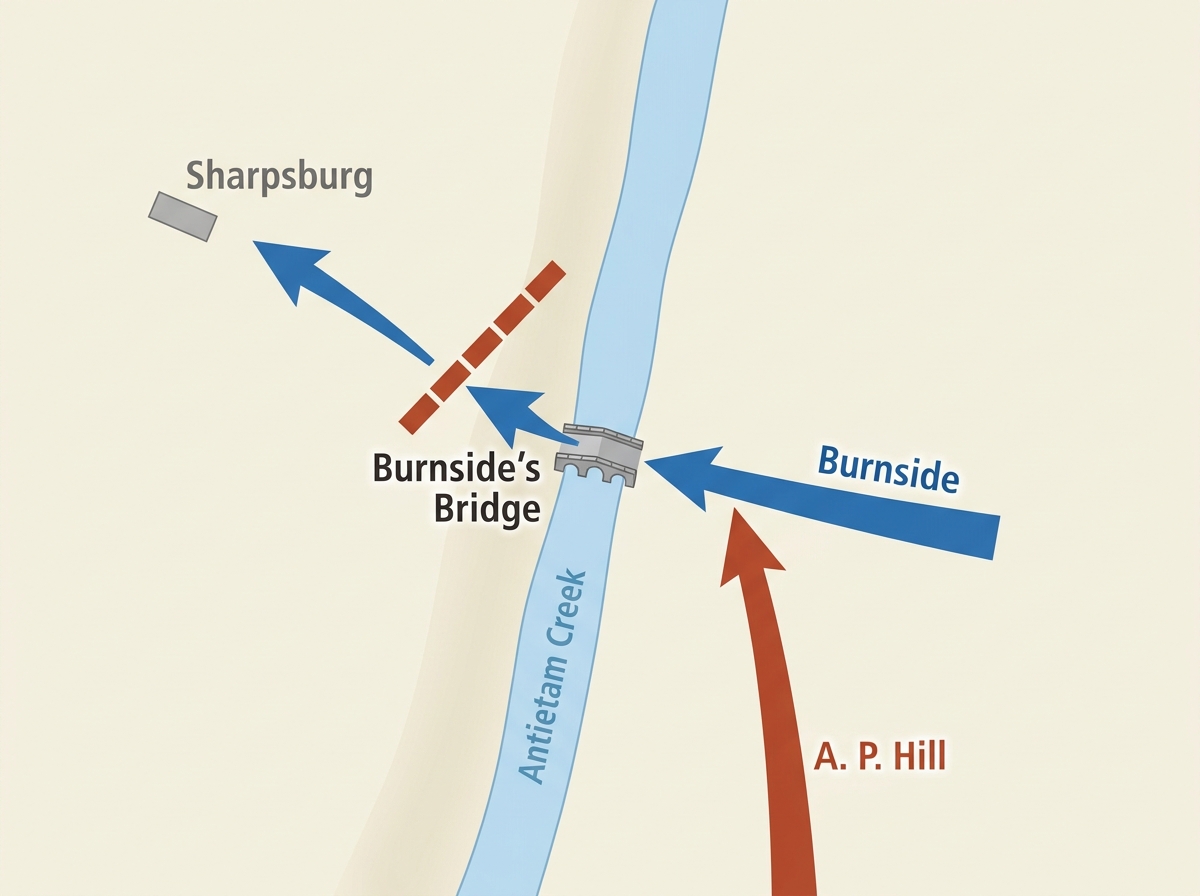
When Burnside’s men finally got across and reorganized, they pushed uphill toward Sharpsburg itself, into the rear of Lee’s exhausted, outnumbered army. And here Lee was finished. He had spent his whole army to hold the morning’s fights; he had nothing behind his right but tired men and empty road, no fresh brigade left to throw in, and Burnside’s blue mass climbing toward the town that anchored his entire line. One more push and the Army of Northern Virginia was done. The Confederate line was about to break for the last time.
And then, out of the south, came the dust of marching men.
A. P. Hill’s arrival
The men were Confederate Maj. Gen. A. P. Hill’s (South) “Light Division,” and they had no business being there yet. They had spent the day on the road, force-marching about seventeen miles from Harpers Ferry to reach the battlefield, some of them dressed in Union blue uniforms captured at the garrison they had just taken. They arrived at the worst possible moment for Burnside and the best possible moment for Lee, slammed into the exposed Union flank, and drove Burnside’s corps back down the slope they had just climbed. The line held. The Confederate army, somehow, was still alive when the sun went down. The battle ended in the dark, with both armies right where they had nearly destroyed each other.