The man who would not flinch
Gustave Courbet (1819–1877) was the kind of self-believer who makes a movement possible and a dinner party unbearable. Born in 1819 in Ornans, a small town in the Franche-Comté countryside near the Swiss border, he came to Paris, taught himself largely by copying old masters in the Louvre, and arrived at a conviction he never once doubted: that the only honest subject was what a painter could actually see, and the only honest scale for it was the scale the Salon had reserved for kings.
So he did the unthinkable, twice, in a single year. In 1849 he painted two laborers — one old, one young — breaking rock by the roadside, The Stone Breakers, and in 1849–1850 he painted an entire village funeral in his hometown, A Burial at Ornans. The era overview introduces both as the opening salvo against the jury. Here we get closer — close enough to see what was actually on the canvases, and why two pictures of nobodies frightened people the way a cannon frightens people.
Two men and a pile of rock
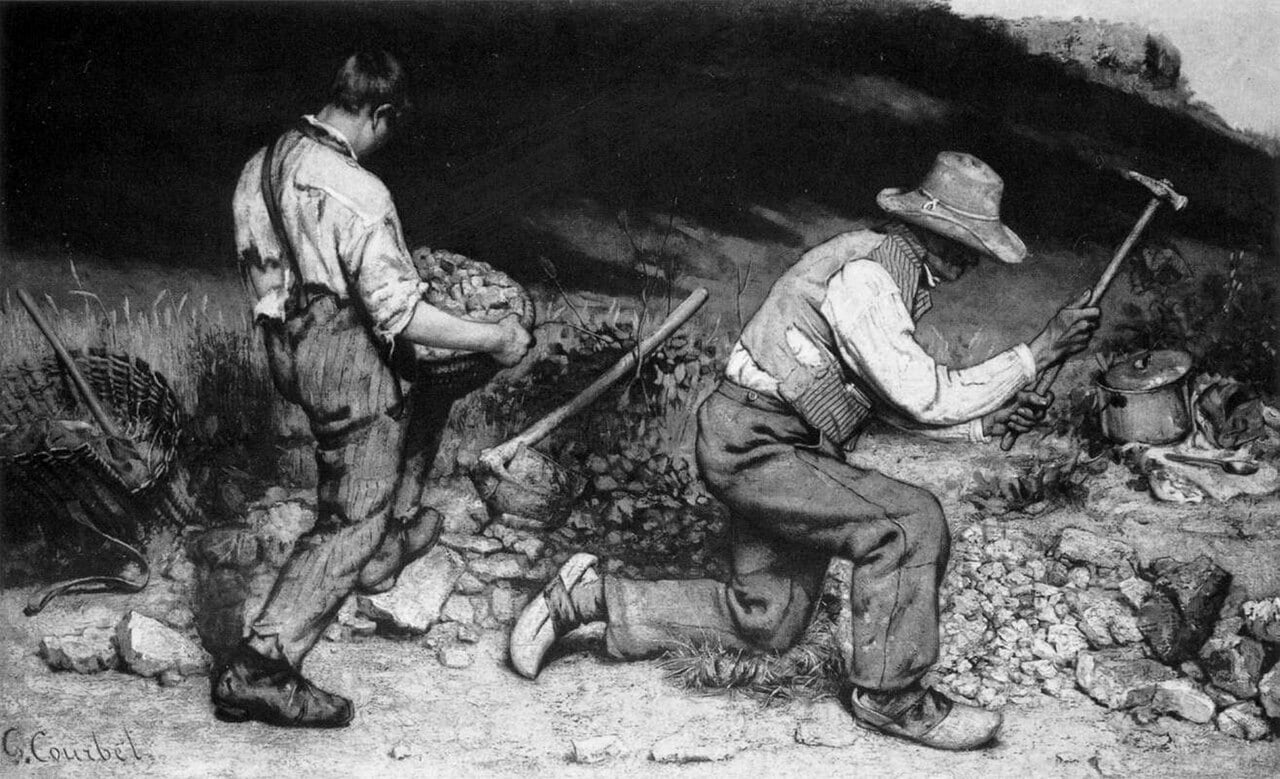
Start with the one you cannot see. The Stone Breakers (1849) showed two figures at the dullest, hardest, lowest work a body can do — a young man straining to lift a basket of broken stone, an old man kneeling to swing the hammer, their backs to us, their faces nearly hidden, their clothes torn at the knee and the elbow. No moral, no sermon, no pretty light. Just labor, life-size, painted with the gravity the Salon spent on saints. Courbet refused to ennoble them and refused to pity them; he simply granted that their work was as real as a coronation, and let the size of the canvas say so.
You have to take that on trust, because you can no longer see the painting. It hung for decades in Dresden, in the city’s old-master gallery, and it vanished in the bombing of Dresden in February 1945. The Dresden museum officially lists it as “missing,” and it is generally presumed destroyed; the exact fate is disputed — one widely repeated account has it lost in transit toward the fortress of Königstein along with 153 other works from the collection, but that is one version, not settled record. Either way, it was never viewable again. What survives are reproductions, like the desaturated one below — so when this read describes The Stone Breakers, it is describing a ghost, reconstructed from copies of a thing that is gone. There is a grim aptness to it: the great picture of the people history grinds up was itself ground up by history.
A funeral the size of a battle
A Burial at Ornans (1849–1850) survives, and it is enormous: roughly ten feet tall and twenty-two feet wide, the kind of acreage the academy handed out for the death of a Greek hero. Courbet spent it on a country funeral.
Stand in front of it and the first thing you register is the sheer ordinariness of the crowd. More than forty mourners are strung in a long frieze across the canvas at life size — townsfolk of Ornans, real local faces, in their real Sunday black, lined up along the lip of an open grave under a flat gray cliff and a flatter gray sky. A priest reads; pallbearers stand; a dog wanders in at the front, indifferent. Nobody is beautiful. Nobody is posed for the ages. There is no shaft of holy light, no swooning grief, no allegorical figure of Death — just a hole in the ground and a row of unremarkable people who will all be in it eventually. It is a funeral painted at the scale of a coronation, with none of a coronation’s flattery, and that mismatch was the scandal. Critics asked, in effect, who told these nobodies they could fill a wall meant for the gods. The honest answer was: Courbet did, and he refused to apologize for it.
That refusal is the gauntlet of the chapter title. He had not merely painted humble subjects — humble subjects were allowed, down at the bottom of the ladder, painted small. He had smuggled them up to the top of the ladder and stood them at heroic scale, and in doing so he had told the entire ranking system that its ranks were a fiction. The jury could feel the threat even when it couldn’t name it.
