A cooperative at war with itself
It is tempting to picture the Impressionists as a band of brothers — comrades against the jury, loyal to the end. The truth is messier and more human: they were a fractious cooperative that spent twelve years and eight exhibitions fighting each other nearly as hard as they fought the Salon. The wonder is not that the group fell apart in 1886. The wonder is that it held together long enough to win.
They mounted eight exhibitions between 1874 and 1886, and almost nobody showed up to all of them. In fact, of the entire shifting cast, exactly one painter exhibited in all eight: the patient eldest, Pissarro, the conscience of the thing, who simply kept turning up. Everyone else came and went depending on the quarrel of the year.
Degas, the engine and the earthquake
The chief quarrel had a name: Edgar Degas (1834–1917). Degas was the group’s organizing engine — tireless about staging the shows, recruiting, arguing — and simultaneously its great internal earthquake. He had two convictions that kept blowing the cooperative apart. First, a hard rule: if you showed with the independents, you were forbidden to also submit to the Salon — no hedging, no double-dipping. Second, he kept insisting on inviting his own allies, Realist illustrators and figure painters who weren’t really doing the bright plein-air thing at all, which the landscape men resented.
Picture how that played in the room. Monet, Renoir, and Sisley still needed Salon sales to eat, and Degas’s no-Salon rule was, to them, a luxury demanded by men with private incomes. So when Degas pressed it — show with us and you may not show there — the landscape men simply walked. They sat out the show of 1879 and stayed out; by the sixth exhibition in 1881, Monet, Renoir, Sisley, Caillebotte, and Cézanne were all absent, leaving the room a largely Degas-faction affair stuffed with his Realist friends. The thing had nearly become two rival shows wearing one name.
Then in 1882 it swung the other way, and the swing had an author: the dealer Paul Durand-Ruel — who had a great deal of his money tied up in Monet, Renoir, and Sisley canvases and needed those names exhibiting together — pushed to get the landscape men back in for what became the most purely Impressionist of the late shows. Degas, contrary to the end, abstained from that one in a huff rather than show beside the plein-air crowd on someone else’s terms. The “Impressionist exhibitions” were, much of the time, an argument with the lights on.
Two more painters drift through this story and matter. Paul Cézanne (1839–1906) showed in the first and third exhibitions, got savaged by the critics, and quietly withdrew to work alone in Provence — he passed through and left, and what he did next would help found the movement that buried Impressionism. He did not arrive untutored: around 1872, the patient Pissarro took the younger Cézanne under his wing out at Pontoise, painting beside him in the fields and coaxing him away from his early murky studio manner toward working directly from nature — Pissarro the conscience again, this time as a teacher. And Gustave Caillebotte (1848–1894) — a wealthy engineer-painter — was the group’s banker, financing several of the shows out of his own pocket and buying his friends’ work when no one else would.
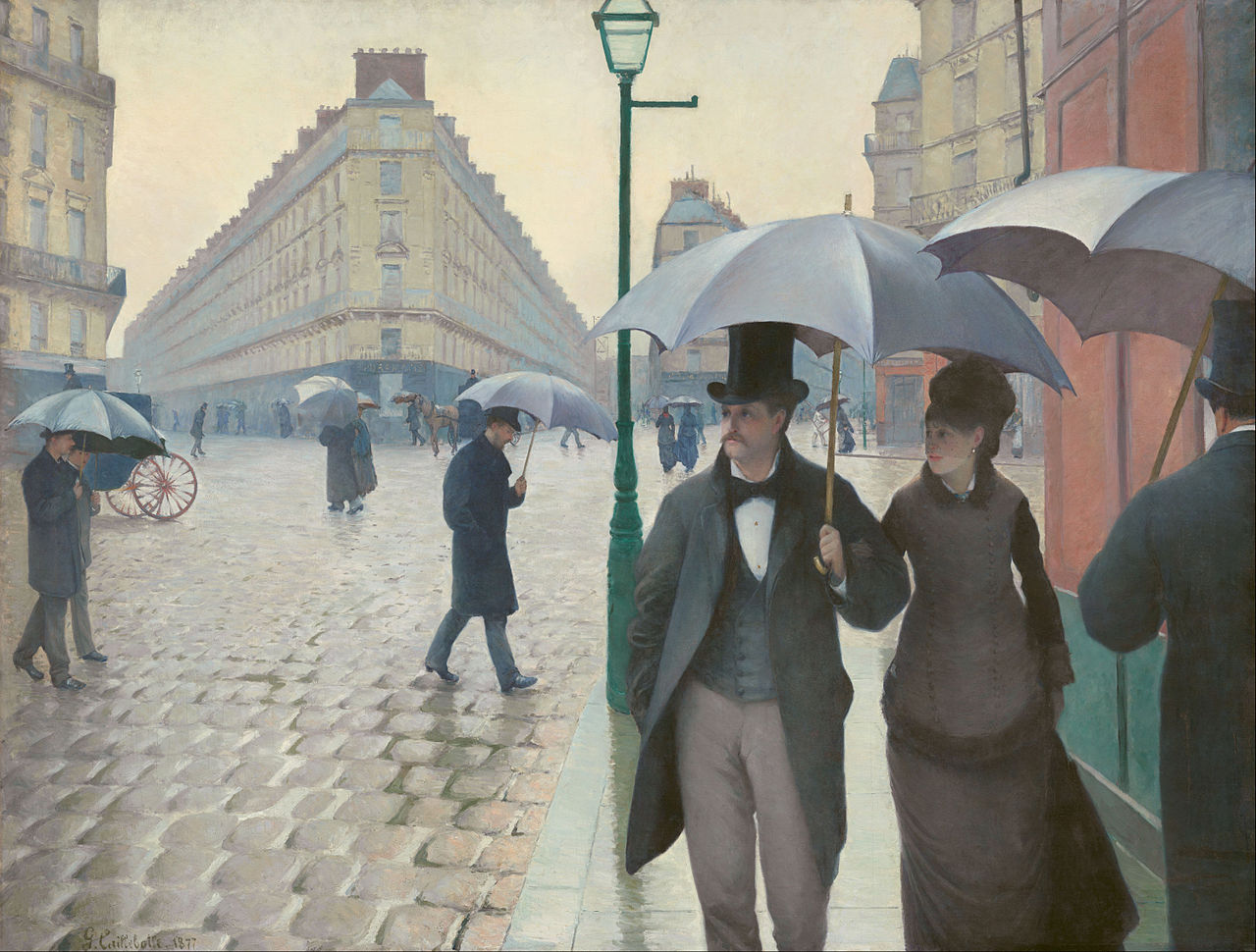
But to leave Caillebotte as the money man would be to miss a real painter. His own canvases are unmistakable: cool, sharp-edged, almost photographic pictures of Haussmann’s new Paris, painted with a hard precision the looser Impressionists never aimed for. The Floor Planers (1875) — three shirtless workmen scraping a parquet floor, muscled and anonymous — was rejected by the Salon as vulgar before he hung it at the 1876 exhibition. Paris Street; Rainy Day (1877) is the masterpiece: a vast canvas of well-dressed Parisians under umbrellas crossing a wet, gleaming boulevard intersection, the cobbles and the great wedge of a new apartment block rendered with an almost architectural exactness. He didn’t just pay for the modern city to be painted. He painted it himself, harder-edged than anyone. (He also left so much of his collection to the French state in his will that the bequest set off a fight — a story this reading saves for its last chapter.)
Durand-Ruel bets everything, twice
A cooperative can hang its own pictures. It cannot, by itself, create buyers. For that the movement needed a dealer — a merchant who buys paintings from artists and resells them at a profit, and who, crucially, can keep an artist alive by paying for work the public hasn’t learned to want yet. The Impressionists’ dealer, and one of the genuine heroes of the story, was Paul Durand-Ruel (1831–1922).
Durand-Ruel did something nearly unheard of: he bet on these painters in bulk. He had met Monet and Pissarro in London during the war (where all three had fled), and from 1872 he began buying their work by the armful — not a canvas here and there, but cornering an artist’s entire output, paying a steady stream so the painter could keep painting. He once bought some two dozen canvases out of Manet’s studio in a single swoop. It was a radical, all-in business model: stockpile an unfashionable artist and wait for the world to catch up.
The world took its time, and the wait nearly destroyed him. By the mid-1880s Durand-Ruel was sitting on a mountain of unsold Impressionist paintings and was close to bankruptcy — he had bought faster than France would buy from him. What saved him was a continent away. In 1886 an American association invited him to bring the pictures to New York, and the New York exhibitions were a hit: Americans, with no Salon prejudice to overcome and new money to spend, bought what Paris still mocked. It opened the entire American market; he opened a New York branch the next year. His own verdict was blunt and grateful: without America, he said, he would have been ruined after buying so many Monets and Renoirs — the two 1886 shows over there saved him.
So follow the irony all the way down. The movement that began with a mocked seascape in a borrowed photographer’s studio was, in the end, kept alive less by the country that produced it than by the country that imported it. The Salon never did come around in time. The buyers came from across an ocean — which is one reason so many of the greatest Impressionist canvases hang today not in Paris but in Chicago, Washington, and New York.