Start at the nail
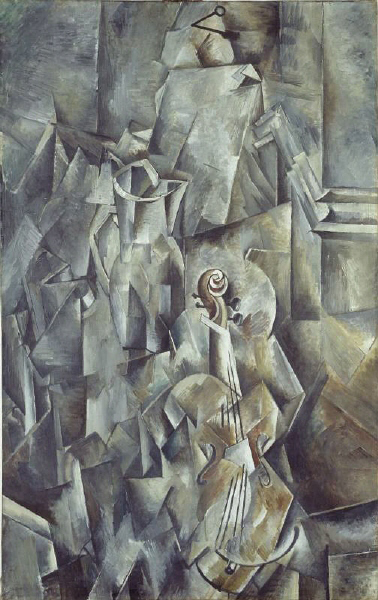
It looks, at first, like a gray avalanche — and the way in is a single odd detail at the very top. Look up there and you will find a nail, painted with old-fashioned, photographic realism, casting a small neat shadow, as if it were hammered into the wall to hang the picture from. After the shock of that one solid, real-looking thing, let your eye fall.
Down in the center and lower half, the violin assembles itself out of the rubble: the little curled scroll (the carved spiral at the top of the neck) near the middle, a few taut strings, and below them the unmistakable rounded body with its two f-holes — the f-shaped slots cut into a violin’s top. Up to the left, a paler cluster of planes with a rounded lip is the jug. Neither object holds still; each one swims into focus and then breaks apart again as your eye moves.
That is the whole experience Braque is after. He builds the violin and the jug right at the brink of legibility — solid enough that you can find them, broken enough that you never quite hold them — and then pins the entire shifting field to the wall with one perfectly real nail. Which raises the obvious question: why, in one of the most radical paintings of its day, paint one flawless illusion?