The joke that holds it up
The nail is the most talked-about detail in early Cubism, and it is doing several jobs at once. The first is simple kindness to the viewer. Surrounded by a faceted fog where nothing sits at a fixed distance, the eye is desperate for one secure thing — and the nail, with its honest shadow, is a foothold: a single point of ordinary, believable space to stand on before you wade into the rest.
The second is wit. Braque has dropped a piece of old-fashioned trompe-l’œil (French for “fool the eye” — painting so realistic it tricks you into reaching for it) into one of the most anti-illusionistic paintings the Cubists had yet made. It is a quiet joke at his own expense, and a flick at the centuries of illusion-painting Cubism was tearing up: you want a convincing illusion? Here is one nail’s worth. Remember, too, that Braque was a decorator’s son, trained to fake wood and marble — the painted nail is the tradesman’s old trick, smuggled into the avant-garde (the small leading edge of artists making the most radical new work). He liked the joke enough to repeat it: a painted nail had already turned up the year before, in his Violin and Palette (now in New York), so this is a deliberate signature, not a one-off whim.
A door about to open
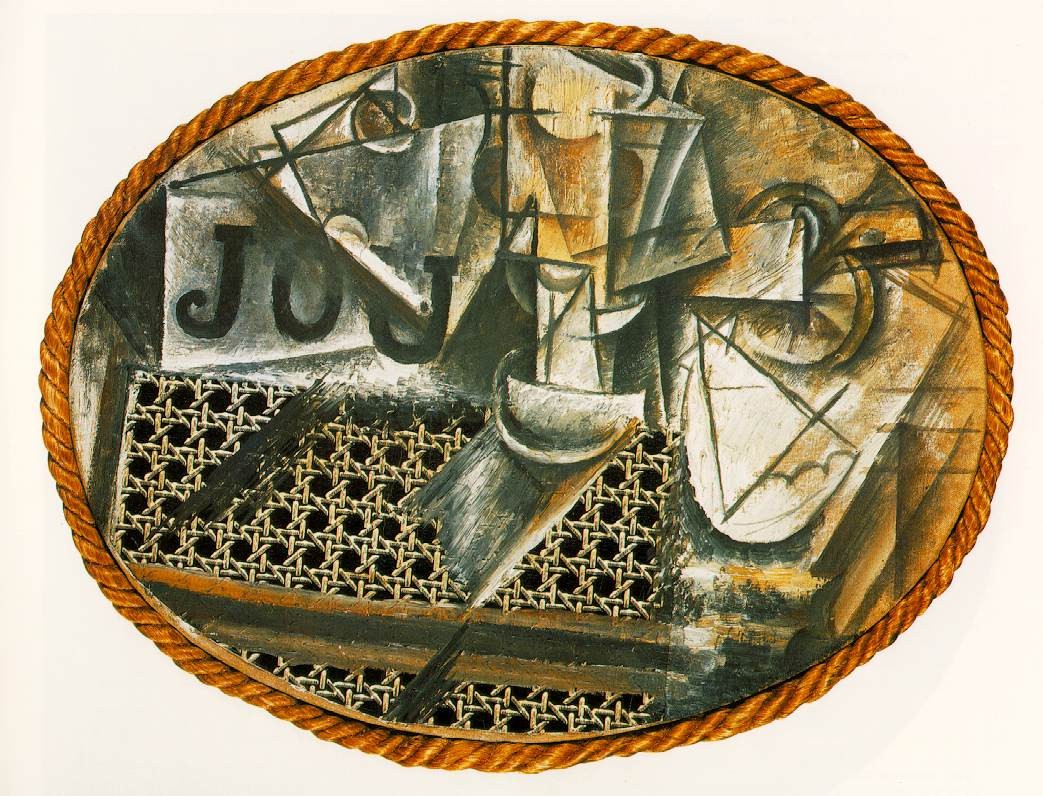
The nail also makes you notice that the picture is a flat object hanging on a wall — not a window into a room, but a thing, with a nail at the top, like any framed board. That is a thought with a future. Within two years Picasso and Braque would stop painting imitations of reality and start gluing real things onto their canvases — oilcloth, newspaper, rope — inventing collage (art made by gluing real materials straight onto the surface). Braque’s painted nail is the hinge: the last and cleverest illusion, made by two painters who were about to decide that the real thing was more interesting than the fake.
The art historian William Rubin, for decades MoMA’s authority on Cubism, thought this canvas the moment Braque came fully into his own — “stunning and magisterial,” he called it. The nail is why.