Roped to Picasso, still
Ayear after Violin and Jug, Georges Braque and Picasso were still “roped together on a mountain,” visiting each other’s studios daily and pushing the same experiment one notch further each time. By 1911 that experiment — Analytic Cubism, the breaking of objects into small faceted planes seen from several sides at once — had reached its most extreme, sealed-off point — so abstract it was nearly a private code. The pictures were faceted so far that the subject all but evaporated into a shimmer of brown and gray.
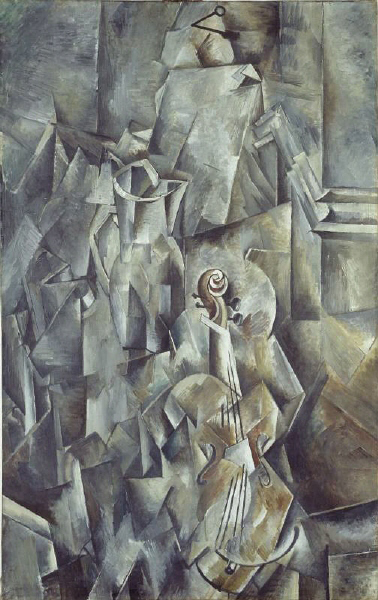
It was a thrilling place to be and a dangerous one. A few more facets and the picture would dissolve into pure abstract pattern, which neither painter wanted. They had been smuggling small clues back in — a curl, a string, a painted nail — to keep the work tethered to the real world. In The Portuguese, Braque smuggled in the most radical clue of all, and it changed what a painting could contain.