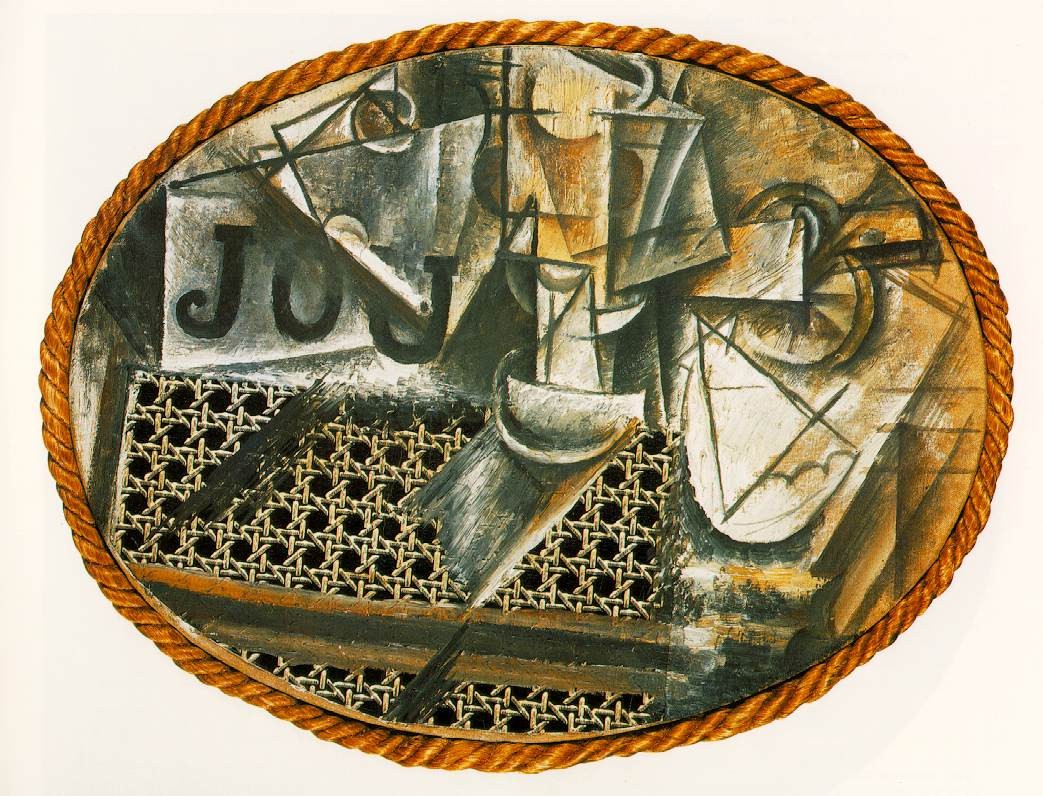
The day type walked in
Stencilled letters in a painting sound like nothing. They were a revolution, for a stack of reasons at once. Braque had let letters in before, in 1910, but as things glimpsed in a scene — words on a real sign. Here they are different: purely flat, purely formal, belonging not to the imagined room but to the surface of the canvas itself. They announce, bluntly, that this is a painted board, not a window you look through. Braque himself explained the logic simply: letters are forms that cannot be distorted — they are flat, with no depth of their own — so their plain presence makes clear the rest of the picture is not pretending to have depth either.
And they are mechanical. A stencil is a sign-painter’s and decorator’s tool — and Braque, remember, was a decorator’s son, trained in exactly these tradesman’s tricks. So the letters drag the cheap, mass-produced world of posters and price tags straight into the most rarefied painting in Europe. In a picture nearly too abstract to read, they are the one thing anyone can read instantly — a fixed, public, printed fact pinned to a private blur.
One year from real paper
Most of all, the letters point straight ahead, to the biggest break in modern art. If a flat, mass-produced printed mark can live in a painting, why paint it at all — why not glue the real thing down? That is exactly the step Picasso took the very next year, pasting a scrap of printed oilcloth onto a canvas and inventing collage — and Braque, that same autumn, ran his own parallel track to it, gluing strips of printed paper into his drawings to make the first papiers collés. Braque’s stencilled D BAL is the hinge: the last move either man made with a brush before they both reached for the glue.