Roped together
From about 1909 Picasso and Braque stopped being rivals and became a two-man laboratory. They lived near each other in Montmartre, visited daily, and worked so closely that Braque later compared it to two mountaineers roped together — if one slipped, both fell. They showed each other every canvas in progress, and sometimes did not sign the fronts, which meant collectors occasionally paid full price for a painting and then had to turn it over to find out whose it was. It is still, more than a century on, genuinely hard for experts to tell some of their pictures apart.
The summer of 1909 is when the experiment clicks into a method. Picasso spent it at Horta de Ebro, his family’s Catalan village, and painted the houses there as a stack of nesting, light-catching cubes — hillside and buildings cut from the same crystalline blocks, the sky pulled down flat behind them.

What 'Analytic' means
Historians call this phase Analytic Cubism, because the painters take an object apart — analyze it — and lay several of its sides down on the flat canvas at once. Picture trying to describe a friend by pinning up their passport photo, their profile and the back of their head in a single frame: that is roughly the deal. The color drains away to browns, grays and ochres, because color would only distract from the real subject, which is structure. A guitar shows you its face, its edge and its sound-hole simultaneously. And the law that had governed European painting since the 1400s — that a picture is a window seen from one fixed spot, with one eye, in one frozen instant — is quietly repealed.
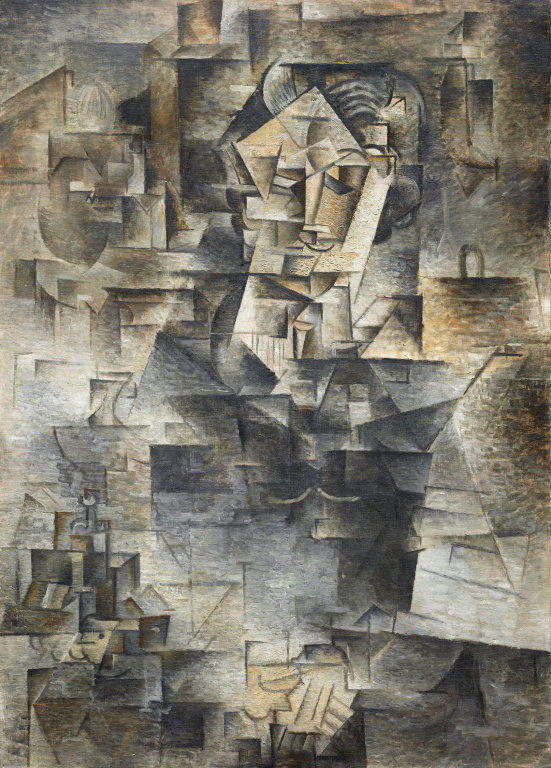
In the autumn of 1910 Picasso painted his dealer, the 26-year-old German Daniel-Henry Kahnweiler, in this new language: a man dissolved into a shimmer of facets, findable only by a watch chain, a wave of hair, a pair of clasped hands. Kahnweiler had been quietly buying almost everything the two of them made and asking for no explanations — the rare early backer who simply trusted them with his money.
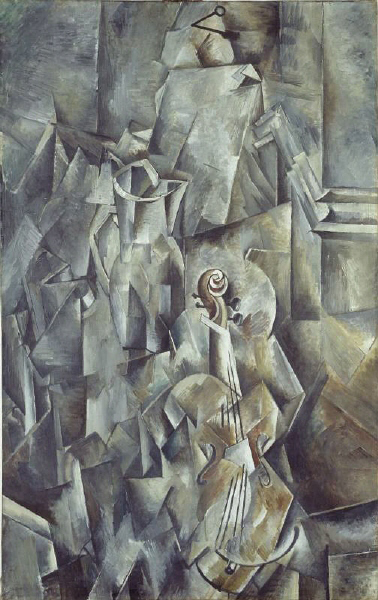
Braque, meanwhile, was doing the same to the still life — a violin, a jug, a folded newspaper — and slipping in a painter’s private joke: a single trompe-l’œil nail (trompe-l’œil is French for “fool the eye” — paint so convincing you nearly reach for it), complete with a cast shadow, hammered into the top of a picture that has otherwise given up on illusion entirely. It is as if he were asking which kind of lie you would prefer.
For two years the pair kept climbing. The higher they went, the harder the pictures were to read — until they reached a height where even they started to get nervous.