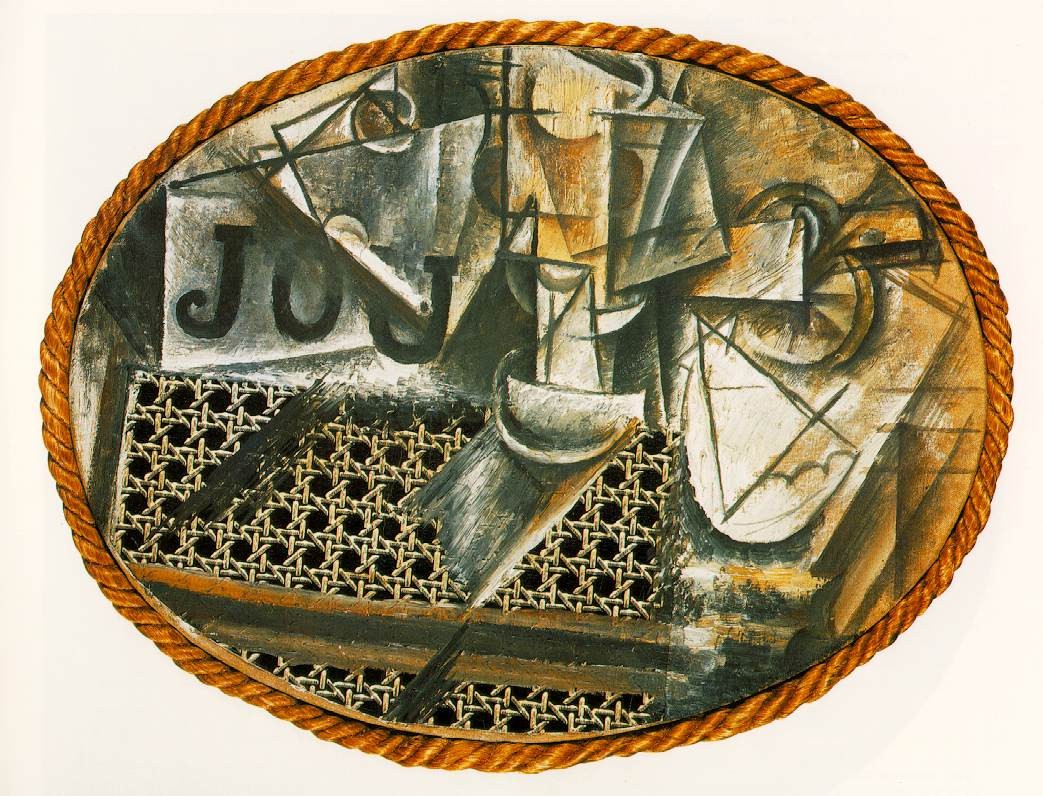
The third man
Every account of Cubism stars Picasso and Braque. There was a third man, quieter, who arrived late and may have understood it best. Juan Gris — born José Victoriano González-Pérez in Madrid — moved to Paris in 1906 and took a cheap studio in the Bateau-Lavoir, the same ramshackle Montmartre building where Picasso lived. He scraped by as a magazine illustrator, watched the two founders invent Cubism above his head, and only around 1911 began painting it himself.
Coming late turned out to be his advantage. Picasso and Braque had bulldozed the path by instinct, arguing and improvising. Gris arrived with a clear head and a draughtsman’s discipline, and set about turning their wild experiment into something you could almost write down as a method. And when, in 1912, the founders started gluing real materials onto canvas — inventing collage— Gris took up the new tool and, within two years, made some of the most beautiful examples anyone would manage. Where Picasso’s and Braque’s surfaces shimmer and dissolve, Gris’s would hold perfectly still — clean, bright, cool, built on a grid you can almost see.