The first viewers
Picasso invited his friends to the studio one by one. The unveiling was a small social ritual: tea, a single candle, the cloth pulled off the canvas. He was nervous. He wanted them to like it. They did not like it.
Matisse was the first big visitor. Matisse was at that moment the most famous living painter in France — the Fauve, the man who had scandalised the 1905 Salon with bright unmodulated color, who was thirteen years older than Picasso and his only real rival. He looked at the Demoiselles for a long time, and then he said it was an outrage, a betrayal of the modern movement, a hoax. He left.
Georges Braque, then 25 and a younger Fauve himself, came to the studio in November. He looked at the painting for a long time. According to the dealer Kahnweiler, he finally said: “Listen, in spite of your explanations, your painting looks as if you wanted to make us eat tow and drink turpentine.” He left too.
A month later Braque was back, painting in something close to Picasso’s new manner.
One person who did like it
Gertrude Stein, Picasso’s American patron and friend, was diplomatic; her brother Leo Stein laughed. André Derain was reported to have said that someone would find Picasso hanging from a beam behind the canvas one day. Sergei Shchukin, the Russian textile baron who was Picasso’s main buyer, looked at the painting and said it was a great loss to French art.
The one early viewer who is recorded as having seen the picture’s importance was Daniel-Henry Kahnweiler, a 23-year-old German art dealer freshly arrived in Paris, who had only recently opened a small gallery on the rue Vignon. Kahnweiler did not try to buy the Demoiselles (Picasso would not have sold it), but he did, from that day, start buying everything else Picasso painted.
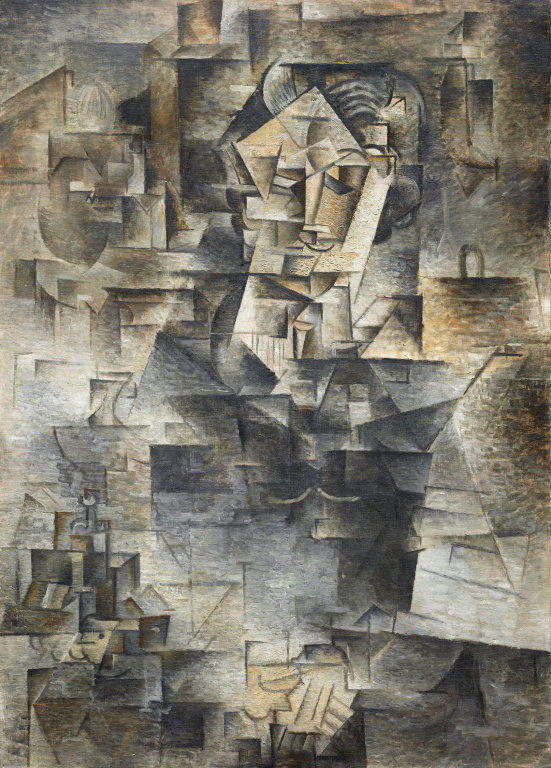
Painting in 1907
To understand why Matisse called it an outrage, it helps to remember that painting in 1907 had rules. They were not the rules of the Royal Academy; the Impressionists had broken those a generation earlier. But there was a tacit modernist code: distort, yes, but for emotional effect; flatten, yes, but for compositional grace; quote non-European art, yes, but as decoration. What Picasso had done was take all three liberties together, without grace, without decoration, and without explanation.
Picasso took the canvas off the wall, rolled it up, and put it away. It would not be seen again in public, except for a brief showing in 1916, for almost a decade.