Doucet's staircase
In 1924 the couturier and book collector Jacques Doucet bought the Demoiselles for 25,000 francs — roughly $1,300 in 1924 dollars, about $20,000 today. The advice he received from his friend the poet André Breton was not to buy it because it was beautiful but because it was, Breton said, the door through which a new century was going to walk.
Doucet hung the painting at the foot of the marble staircase in his Paris apartment. Visitors complained, in their later memoirs, about having to climb the stairs past it. Doucet’s widow consigned it for sale in 1937. It went unsold in Paris and was shipped to New York.
MoMA, in exchange for a Degas
In 1939 the Museum of Modern Art acquired the Demoiselles in a complicated three-way trade. The museum gave up a Degas — Race Course at Longchamp — and roughly $24,000 in cash, drawn from the Lillie P. Bliss Bequest. The total value of the trade in 1939 dollars was about $28,000. Today that is approximately $620,000.
The painting has hung at MoMA, with a few short-lived rearrangements and one loan, ever since. It has been valued by private estimators (it has never been re-sold) above one billion dollars.

The painting in the textbooks
By the 1950s the Demoiselles had become, in the textbooks, the canvas where modern painting actually began. By the 1980s the more interesting question had become whether anything could have happened in twentieth-century painting WITHOUT it. By the 2000s a generation of scholars had begun to point out — quite correctly — that the act of importing the formal language of African masks without acknowledging their makers had aesthetic and ethical costs we are still working through.
All of which is true. And the painting hangs at MoMA, and a new generation of young painters stand in front of it every year and try to understand what it is. They cannot, exactly. That, one might argue, is what makes it the painting that it is.
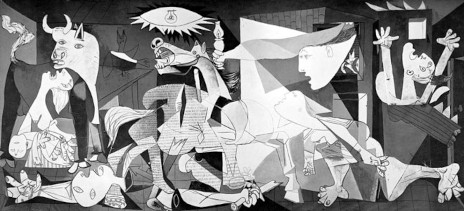
Picasso himself painted for another sixty years. His most famous later canvas — Guernica, made in a month in 1937 for a republic already losing a war — is exactly the kind of work this app often can’t hand you in full. Painted after 1930, it is still under copyright in the United States, not only abroad. So here it is the way the rights regime leaves it: a small reference, with the prose carrying the picture you can’t be shown.
It has never been resold. It has been loaned exactly once, to the Musée Picasso in Paris, in 1988. It will probably never be sold.