Roped together, out on a ledge
By the start of 1912, Picasso and Georges Braque (a young French painter who had become his almost-daily collaborator) had spent three years doing one thing with ferocious concentration: taking the visible world apart. Their method was Analytic Cubism — breaking an object into small flat facets, the little angled planes you see on a cut gem, and laying them out from several viewpoints at once, all in a drab fog of browns and grays. They worked so closely they stopped signing the fronts of their canvases; you had to turn a picture over to learn whose it was.
It was a triumph, and it was a trap. Each picture took the subject a little further apart than the last, and by 1911 the canvases had been faceted almost past reading — a shimmering gray scaffold in which you had to hunt for a mustache or the neck of a bottle to prove there was anything there at all. Set a Braque still life from these years in front of you and you can feel the problem: it is beautiful, and it is nearly illegible.
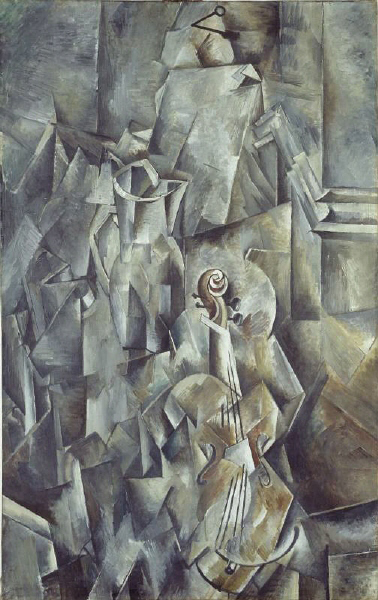
A few more facets and it's wallpaper
The danger was abstraction — and, oddly, neither man wanted it. A few more facets and the subject would vanish entirely, leaving only a handsome arrangement of grayish shapes: decoration, pattern, wallpaper. Picasso and Braque were not trying to leave the world behind; they were trying to show it more truthfully, from more sides at once. They had climbed out onto a ledge and could feel that one more step in the same direction was a drop.
The window that had to go
To see why the next move mattered so much, you have to know what these two were rebelling against. Since the Renaissance had worked out the geometry of perspective around 1420, a Western painting had been understood as a window: a flat surface you look through, faked so skilfully with paint and shadow that you seem to see a real room, a real face, real fruit. The whole game was illusion — make paint pretend to be something it isn’t.
Cubism had already smashed that window: no single viewpoint, no convincing depth. But Analytic Cubism had replaced the illusion with something close to abstraction, and that was a dead end too. The question hanging over Picasso’s studio in the spring of 1912 was simple and enormous: how do you let the real world back into a picture without going back to faking it? The answer, when it came, was not something he painted. It was something he glued.