Look down at the table
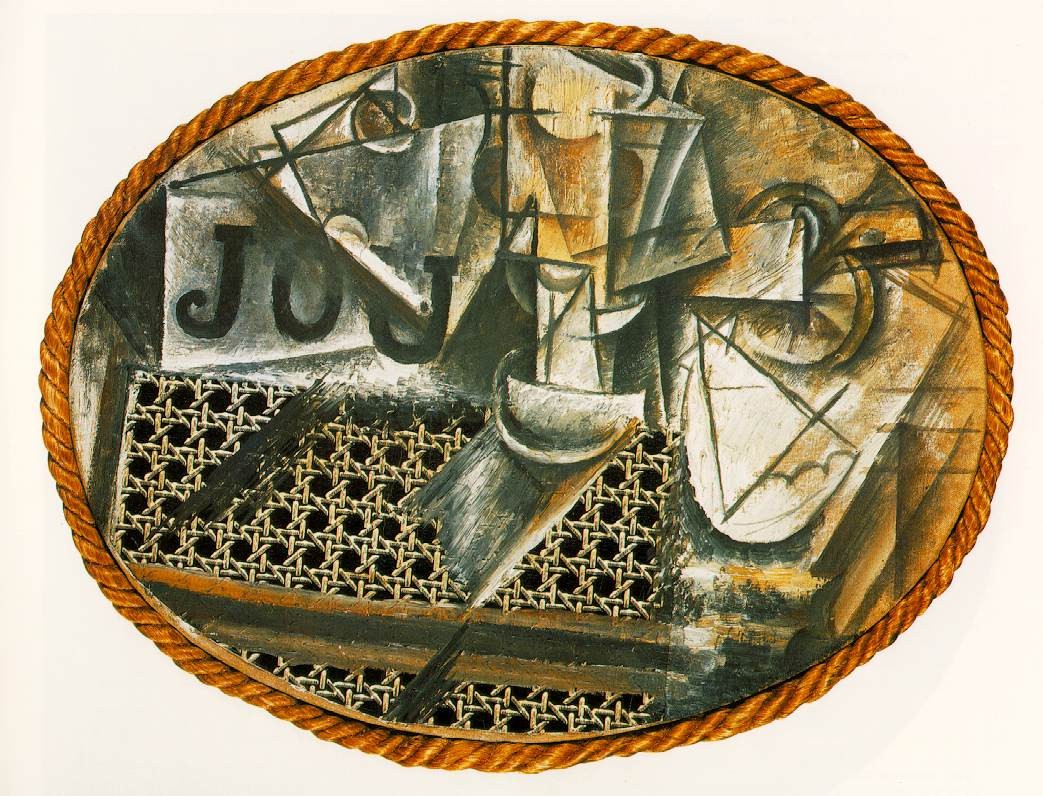
At first it is a brown jumble, and you may want to give up. Don’t — it is a scene, and once it clicks you can’t un-see it. You are looking down at a small round café table from directly above, the way you’d glance at your own table mid-conversation. Start with the patch of woven mesh in the lower left: that is the printed chair caning, standing in for the seat of the chair you would be sitting on. The whole picture is your point of view at the café.
Now read the tabletop. Those bold black capitals — JOU — are the corner of a newspaper: the first three letters of journal, the French word for a paper (literally “daily”). Cafés kept the day’s papers for customers; here one lies folded on the table. Readers have long enjoyed the side-joke that jou also opens jouer, “to play” — a fair wink, given how much of this picture is a game, though it’s the newspaper that’s literally on the table.
Around the JOU, the rest of the meal assembles itself out of the gray facets: the bowl and stem of a wineglass, the curve of a pipe, the blade of a knife, a wedge of lemon, the fluted shell of a scallop. It is the debris of an apéritif (a pre-lunch café drink) and a light meal — the most ordinary half-hour in Paris, rendered in the most advanced painting in Europe.
The fake that tells the truth
Here is the move that makes the picture famous. Everything painted on this table is an illusion: hand-made fakery, paint pretending to be a glass or a lemon. The caning is the opposite — it is a real thing, an actual manufactured object stuck to the canvas. Except that the real thing is itself a fake: a printed picture of cane, not cane. It is as if, to explain what money is, you hung a flawless painting of a banknote beside a real banknote — and the real one turned out to be a film prop. Picasso has stacked illusion on illusion on reality in one small oval: hand-painted fakes, beside a real object, that is a machine-made fake. The picture is a little essay on the difference between a thing and a picture of a thing, and it pointedly refuses to settle the question.
The Met’s own catalog puts the whole revolution in a phrase: Picasso had found a way of inserting a fragment of reality into the fictive realm of painting — a scrap of the actual world, glued into the make-believe.